Working Principle
Cold heading equipment plastically deforms metal billets through the cold heading process to obtain the required parts. During cold heading, the metal billet is typically placed inside a die cavity at room temperature and subjected to pressure from a punch, causing plastic deformation and ultimately forming a part of the predetermined shape. The core of this process lies in utilizing the plastic properties of the metal material to achieve material flow and redistribution through local pressing, without the need to heat the billet. This process not only significantly improves the mechanical properties of the part, such as strength and hardness, but also effectively enhances surface quality. Furthermore, the application of hydraulic cold heading technology further improves the operational stability and safety of the equipment, ensuring precise forming results even under high-pressure conditions. Cold heading equipment is usually equipped with a high-precision control system to ensure the uniformity and consistency of each deformation, thereby meeting the efficient production needs of parts with complex structures.
Types and Characteristics
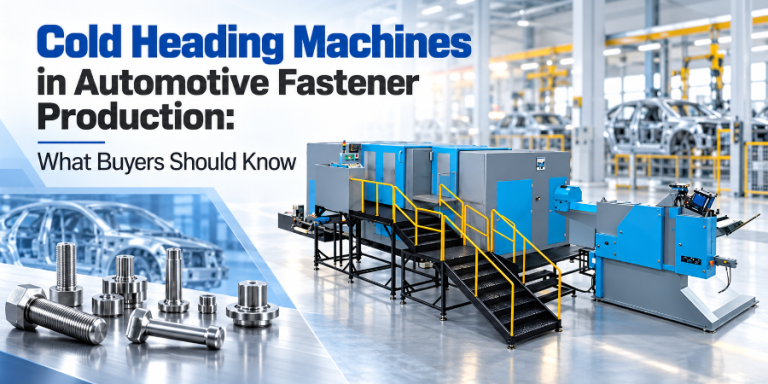
Cold heading equipment can be divided into various types based on its functions and structural features, among which multi-station cold heading machines and high-speed cold heading machines are the two most common. Multi-station cold heading machines are renowned for their efficient integration of multiple processes, capable of completing several processing steps from billet to finished product in a single operation, significantly enhancing production efficiency and part accuracy. This type of equipment is widely used in the manufacturing of parts requiring complex forming processes, such as high-strength bolts and nuts in automotive engines. In contrast, high-speed cold heading machines excel with their superior production speeds, making them particularly suitable for the mass production of small fasteners, such as miniature screws in electronic connectors. Additionally, with the continuous advancement of automation technology, modern cold heading equipment is also equipped with intelligent control systems and online monitoring functions, enabling real-time adjustment of process parameters and product quality inspection, thereby further expanding its scope of application.
Advantages in the Manufacturing Industry
Cold heading equipment demonstrates significant advantages in modern manufacturing, particularly excelling in improving production efficiency, material utilization, and product accuracy. First, since the cold heading process does not require heating the billet, it substantially reduces energy consumption and production costs, while shortening the processing cycle and significantly boosting production efficiency. Second, the plastic deformation characteristics of the material during cold heading allow the billet to be fully utilized, with almost no cutting waste, thus achieving a high material utilization rate. This feature is particularly important against the backdrop of increasingly scarce resources. Furthermore, through high-precision die design and advanced control systems, cold heading equipment can ensure that the dimensional accuracy and surface quality of parts reach a high standard, meeting the strict performance requirements for components in high-end manufacturing. These advantages make cold heading equipment an indispensable key manufacturing asset in industries such as automotive, machinery, construction, and electronics.
 Skip to content