Reading time: ~8 min | Categories: Cold Forging Technology, Industrial
 Skip to content

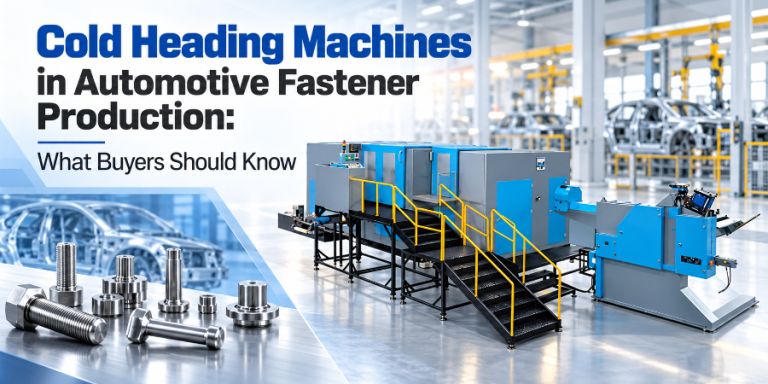

A fastener in a consumer product can fail without consequence, but a fastener in a suspension arm or a brake caliper carries the whole vehicle when it moves. That difference is why automotive supply chains set the selection bar higher than almost any other market. Choosing a cold header for automotive work therefore means choosing process discipline first and machine spec second, and the two cannot be separated once the parts enter the OEM chain.
Automotive fasteners are defined by three demands that general hardware never faces together. The strength grade is fixed, often 8.8, 10.9, or 12.9, and must hold across millions of pieces rather than across a sample. The consistency must survive the full production run, because a dimension that drifts at hour eight of a shift is a recall risk. The part must be traceable, with IATF 16949 discipline and PPAP documentation that ties each lot back to its process settings. A former that cannot support that paper trail is disqualified before its first bolt.
Cold heading meets those demands by how it forms the part. The process is near net shape, so the geometry leaves the die close to finished and stays uniform from piece to piece. The grain flow follows the part contour instead of being cut across, which raises fatigue strength where automotive joints need it most. Because every station fires on the same timed stroke, the cycle is stable enough to hold the consistency the spec requires. The method is not chosen for speed alone. It is chosen because the output behaves the same way on the last part as on the first.
Cylinder head bolts, connecting rod bolts, suspension bolts, and brake caliper fasteners are the core automotive case for cold heading. These parts sit in the 10.9 and 12.9 classes where fatigue life decides service safety, and they are produced in volumes that only a high cycle former can serve. The grain flow benefit and the stable cycle are exactly what this category needs, which is why the process is standard across engine and chassis lines.
Inside the cabin and the control units, ECU terminals and connector pins are small, precise, and produced in huge counts. Cold forming gives the surface finish and dimensional repeatability that plating and mating require, and it saves the material that machining would waste at this scale. The part is tiny, but the consistency demand is the same as the structural bolt, because a loose terminal is a fault just as a loose caliper bolt is.
Automotive bodies and modules also use shaped brackets, combined pins, and formed components that leave the standard envelope. These need tooling freedom rather than a dedicated standard header, which is where flexible part formers earn their place. The DBP-136L part former covers 8 to 12 mm non standard bodies, and the DBP-206L six station part former extends that to 12 to 20 mm for the larger shaped components in the mix.
The first failure is consistency drift, where slow die wear changes a dimension just enough to fall outside the window by the end of a run. The second is surface defects, cracks or seams that trace back to poor wire condition or weak lubrication rather than to the machine itself. The third is mix up, a wrong grade or wrong part entering a lot because the traceability step was loose. None of these are dramatic. They are the quiet gaps that an audit finds and a recall later proves, which is why the process control matters more than the peak speed.
A general former makes acceptable bolts for non critical use at lower cost and with lighter documentation. An automotive grade former adds the control layer the OEM chain requires, from stable cycle tuning to in line inspection and lot logging. The comparison is not about whether the bolt looks right. It is about whether the machine can prove the bolt was right, lot after lot. For automotive supply, that proof is the product, and the former is only as good as the record it leaves.
Cylinder head and exhaust manifold bolts live in heat and load, so the 10.9 and 12.9 grades and the fatigue resistant grain flow are non negotiable. A cold header feeding an inline thread roller delivers the consistent strength class these joints demand, with the dimensional control that keeps the audit clean.
Tier suppliers ship to OEM lines on tight schedules under PPAP and just in time terms. The former must hold the rate and the documentation together, because a late or non conforming lot stops a line that costs far more than the fasteners. Cold heading fits this model because the stable cycle and the traceable setup are built into how the process runs.
Cold heading makes the formed blank, not the finished heat treated or coated part. Special coatings and the quenching and tempering that set the strength class are downstream operations, usually at separate stations or suppliers. The former must be specified to deliver a blank that those steps can take cleanly, which means the buyer plans the whole chain rather than the single machine.
Quality is set before the part is boxed. Process control starts with wire pre treatment and lubrication so the steel flows instead of seizing, and it continues with station timing held to the qualified window. In line inspection, optical or gauging checks at the machine, catches drift before a full lot is wrong. Batch traceability, logging each lot to its tooling and settings under IATF 16949, is what turns a good run into an auditable one. Hold those three and the former does not just make bolts. It makes evidence.
The machine is set by the OEM standard first, because automotive work is defined by the grade, the consistency, and the traceability the buyer must prove. For small high volume fasteners, the DBHP-6 high speed cold former reaches 450 pieces per minute for M6 and the DBHP-8 handles M8 at 350 pieces per minute. The DBF-134L cold forming machine covers standard 8 to 12 mm bolts, while the DBP-136L part former and the DBP-206L six station part former add non standard freedom up to 20 mm.
Because the process holds the three things automotive needs together: a fixed strength grade across millions of pieces, stable consistency from the first bolt to the last, and a traceable setup. Cold heading delivers near net shape and contour following grain flow, which supports fatigue strength while keeping the cycle repeatable enough for audit.
Yes. Cold heading produces the blank, and the strength class such as 10.9 or 12.9 is reached through the downstream quenching and tempering step. The former must deliver a clean, consistent blank that those heat treatment steps can take, so the high strength comes from the full chain rather than from heading alone.
Consistency comes from process control, in line inspection, and batch traceability working together. Wire pre treatment and held station timing keep the part stable, machine side checks catch drift early, and lot logging under IATF 16949 proves the run was in window. The record is as important as the bolt.
Yes. Connector pins and ECU terminals are formed cold in high counts, because the method gives the surface finish and repeatability that plating and mating need while saving the material that machining would waste. The part is small, but the consistency demand matches the structural fastener.
Use a flexible part former rather than a dedicated standard header. The DBP-136L covers 8 to 12 mm non standard bodies and the DBP-206L extends to 12 to 20 mm, both holding the tooling freedom that shaped brackets and combined components require within the automotive mix.
Reading time: ~8 min | Categories: Cold Forging Technology, Industrial
Table of Contents Introduction The Fundamental Difference in Material Usage
1. Introduction Walk into any fastener manufacturing facility and you
1. Introduction When you manage a high-volume fastener plant or
 Optimized by Seraphinite Accelerator