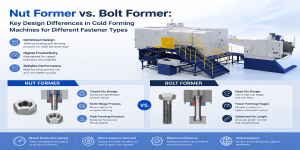
1. Introduction Walk into any fastener manufacturing facility and you
 Skip to content

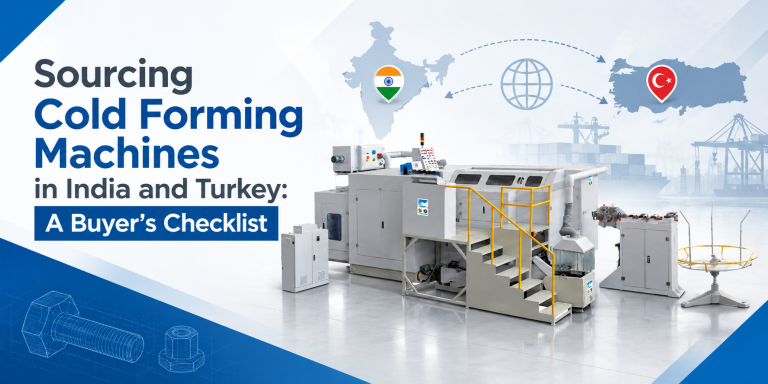
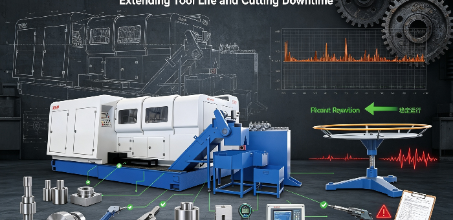
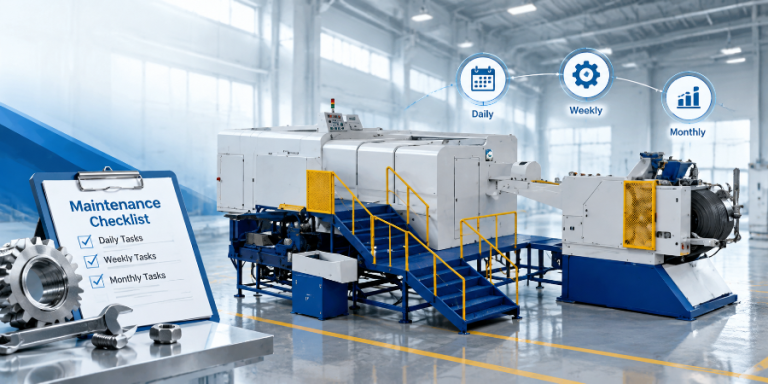
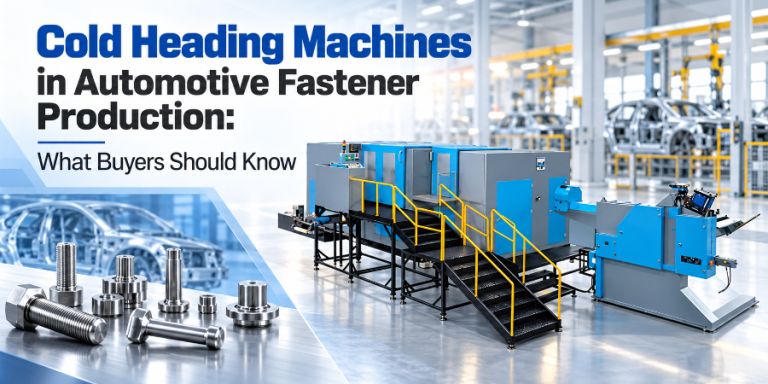

A plant that runs a million hex bolts a month and a plant that builds five hundred shaped brackets a week are both making fasteners, yet they fail for opposite reasons when they buy the wrong machine.This article separates standard from non standard work, shows which former fits each and explains why the mismatch shows up as scrap and downtime rather than as a line that simply will not start.
A standard fastener is defined by a published specification, whether ISO, DIN, or ANSI, that fixes the diameter, head shape, thread length, and tolerance. Hex bolts, socket screws, and studs in catalog sizes are the typical cases. Because every part is the same geometry, the machine can be set once and left, with tooling tuned to a single known envelope. The economics reward repeatability, and a dedicated former earns its keep by holding tight tolerance at high cycle with minimal changeover.
Non standard parts break one or more of those fixed rules. The body may be shaped rather than round, the part may combine functions such as a bolt with an integrated washer or a pin with a formed end, or the material may be stainless, alloy, or pre coated wire that forms differently from mild steel. Each variation demands tooling freedom, because the machine must place a feature the standard header was never built to hold. The former that serves this work is measured by flexibility as much as by speed.
For bolts from 8 to 12 mm in diameter and up to 160 mm in length that stay inside the standard envelope, the DBF-134L cold forming machine is the straight fit. It is built for standard production, so setup is simple and the run stays stable once the tooling is set. A plant that knows its volume is standard parts in this range gains little from a more flexible frame.
When the same 8 to 12 mm range must also absorb shaped or combined parts, the DBP-136L part former covers both. It produces standard bolts at the same diameter and length as the DBF-134L, yet carries the tooling freedom for non standard bodies. For a shop with a mixed book in this range, one machine replaces the gap that would otherwise need two.
Larger work from 12 to 20 mm and up to 220 mm long sits with the DBP-206L six station part former. Its six stations handle the extra features that long or shaped parts carry, and it serves both standard and non standard bodies in that diameter band. Where the part is big and the mix is varied, the station count is what keeps the former flexible without a second machine.
The first failure is tool incompatibility, because a standard former has no station or punch for a feature the custom part requires. The second is scrap, since forcing a shaped body through a header built for one geometry leaves short fills, cracks, or off tolerance heads that the line cannot pass. The third is downtime because the gap is often closed by hand with a second operation or a workaround that stops the machine. None of these announce themselves at purchase. They surface in the reject bin and the idle hours once the non standard order arrives.
A dedicated standard former wins on simplicity and cost per piece for catalog parts because every element is tuned to one known job. A flexible part former costs more and takes longer to set, but it absorbs the non standard order without a second machine or an outside supplier. The comparison is decided by product mix. A shop that never leaves standard territory should not pay for flexibility and a shop that lives in custom work cannot afford a former that cannot bend.
A line shipping hex bolts and screws by the container loads on a fixed schedule gains nothing from tooling freedom. The DBF-134L class machine holds the tolerance and the cycle, and the absence of changeover is the feature. Here the standard former is not a compromise. It is the right tool for a single known part.
A job shop that quotes a different shaped bracket each week needs the DBP-136L or DBP-206L freedom, because the value is in accepting the order rather than in the cycle of any one part. Quick changeover and a tool library let the same frame serve the book, and the flexibility is what keeps the shop independent of subcontractors.
Flexibility has a ceiling. An extreme non standard part with features the station count cannot contain still needs dedicated tooling or a different process, and no part former turns into a press or a machining center. Recognizing that boundary protects the buyer from expecting one machine to cover work it was never shaped to hold.
Flexibility is managed at the edges, not bought whole. A tool library that stores preset punch and die sets by part cuts the changeover from a rebuild to a swap. Quick changeover fixtures and rehearsed transfer timing keep the downtime short between orders. Fixture management, the discipline of labeling and storing tooling so the next setup starts from a known state, is what separates a flexible former that pays from one that sits half tuned. Hold those three and the machine serves the mix instead of fighting it.
The machine should follow the product mix, not the catalog photo. If your volume is standard 8 to 12 mm bolts, the DBF-134L cold forming machine is the direct answer, while the DBP-136L part former adds non standard freedom in the same range and the DBP-206L six station part former covers 12 to 20 mm. For smaller diameters, the DBHP-6 high speed cold former reaches 450 pieces per minute for M6 and the DBHP-8 handles M8 at 350 pieces per minute.
Not without limits. A standard former makes catalog parts cleanly but lacks the stations and tooling freedom for shaped or combined bodies, so non standard work drives scrap and downtime. A flexible part former bridges both, though it costs more and suits shops with a real mix rather than pure standard volume.
Within 8 to 12 mm and up to 160 mm length, the DBP-136L forms shaped bodies, combined parts such as bolt with integrated features, and non standard geometries that the DBF-134L cannot hold. It keeps the standard bolt capability and adds the tooling freedom for custom work in the same diameter band.
Choose the DBP-136L. The DBF-134L is built for standard 8 to 12 mm bolts only, so a non standard part in that range needs the DBP-136L flexibility. If the book is purely standard, the DBF-134L is the simpler and lower cost choice.
The DBP-206L six station part former covers 12 to 20 mm at up to 220 mm length for both standard and non standard bodies. Its six stations carry the extra features that long or shaped parts require, which is why it fits the larger non standard work.
A single tool set serves one part family with fixed diameter, head, and length. The former is flexible across families, but each family still needs its own tuned tooling.
1. Introduction Walk into any fastener manufacturing facility and you
Table of Contents Introduction The Fundamental Difference in Material Usage
1. Introduction When evaluating cold forming machines, the first number
1. Introduction In the highly competitive fastener manufacturing industry, efficiency,
 Optimized by Seraphinite Accelerator