Table of Contents Introduction What thread rolling is What thread
 Skip to content
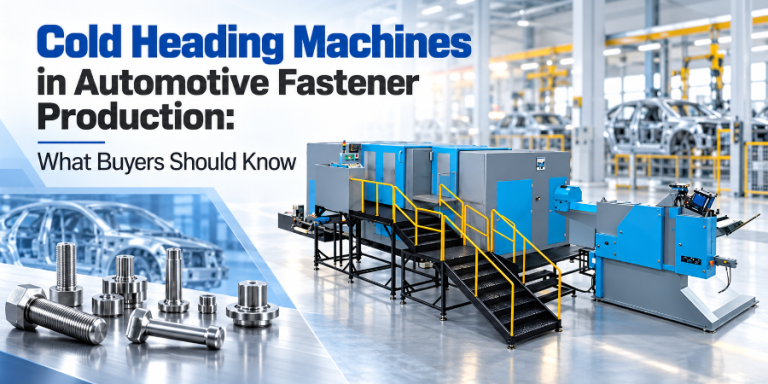
When evaluating cold forming machines, the first number most buyers look at is the output rate — typically expressed in pieces per minute (pcs/min) or strokes per minute (SPM). A machine rated at 450 pcs/min sounds impressive, but what does that number actually mean for your production? Can you expect 450 finished parts every minute, every hour, every shift?
The reality is more nuanced. A cold former’s rated speed is its maximum mechanical cycle rate under ideal conditions — a specific wire diameter, a standard part geometry, a particular material, and continuous operation without interruptions. In actual production, effective output is determined by the interplay of rated speed, material type, part complexity, station configuration, changeover frequency, and equipment uptime.
This guide breaks down the factors that determine cold former speed, explains how to read spec sheets critically, and provides a practical framework for matching machine capability to your actual production demand. Whether you are producing millions of standard M6 bolts per month or smaller batches of specialized M16 structural fasteners, the goal is the same: select a machine whose sustainable output aligns with your demand — without overpaying for speed you will never use or underinvesting in capacity you critically need.
Table of Contents
A multi-station cold heading machine completes one full production cycle per stroke — but that cycle is not instantaneous. Each stroke involves a sequence of mechanical operations, and the slowest of these operations becomes the limiting factor for overall machine speed. Understanding these stages helps explain why two machines with similar ratings may perform differently in practice.
Every cold forming cycle includes the following sequential operations. The time required for each stage contributes to the minimum cycle time — and therefore the maximum SPM the machine can achieve:
| Stage | What Happens | Speed-Limiting Factor |
|---|---|---|
| 1. Wire Feed | Wire is drawn from coil, straightened, and fed into the machine to a precise length | Feed roll grip, wire diameter tolerance, straightener efficiency |
| 2. Cutoff | A cutoff knife shears the wire to create a precisely sized slug (blank) | Cutter blade sharpness, wire hardness, slug length accuracy |
| 3. Transfer | The slug is gripped by transfer fingers and moved to the first forming station; between stations, the part is transferred sequentially | Transfer mechanism type (cam-driven vs. servo), finger synchronization, part weight |
| 4. Forming (Blow) | The ram drives punches into dies at each station, progressively forming the part | Ram stroke length, forming force required, material flow stress, number of stations |
| 5. Knockout | Knockout pins eject the finished part from the final die station | Knockout stroke length, part geometry (long parts require longer knockout travel) |
The ram stroke is typically the primary speed determinant — longer strokes require more time per cycle, which is why machines designed for longer parts (like the DBF-134L with a 270mm main ram stroke for bolts up to 160mm) operate at lower SPM than machines for shorter parts (like the DBHP-6 with a 100mm stroke for M6 bolts up to 50mm shank length).
The material being formed directly affects the safe operating speed. Higher-strength materials require greater forming force and generate more heat, which means the machine must run slower to avoid tool damage and dimensional instability:
This means a machine rated at 450 pcs/min for mild steel M6 bolts may need to run at approximately 290–300 pcs/min when forming SS304 fasteners of the same size. Always confirm with the manufacturer what material and part geometry the rated speed applies to.
Machine spec sheets typically list a single output rate — for example, “450 pcs/min” for the DBHP-6 or “350 pcs/min” for the DBHP-8. This number represents the maximum mechanical stroke rate under specific reference conditions: a standard part geometry, a specific wire diameter, and mild steel material. It does not represent the output you will achieve across all part sizes and materials.
As part diameter increases, the forming force required increases, the ram stroke must be longer, and the safe operating speed decreases. This relationship follows a general pattern across the industry:
| Part Size Range | Typical Speed Range | Dongrui Machine Match |
|---|---|---|
| M3–M6 (small fasteners) | 150–450+ SPM | DBHP-6 — 450 pcs/min, 300T |
| M5–M8 (medium fasteners) | 150–350 SPM | DBHP-8 — 350 pcs/min, 400T |
| M8–M12 (standard bolts) | 75–110 SPM | DBF-134L — 75–110 pcs/min, 120T |
| M12–M20 (large/non-standard) | 40–70 SPM | DBP-206L — 40–70 pcs/min, 390T |
Three different speed metrics matter when evaluating a machine, and confusing them leads to overestimating production capacity:
For example, the DBHP-6 is rated at 450 pcs/min. In continuous production of standard M6 mild steel bolts, a realistic sustainable speed might be 330–380 pcs/min (75–85% of rated). After accounting for a 1–2% scrap rate and minor operational interruptions, effective output might be 300–350 pcs/min. This is still excellent — but it is not 450.
The number of forming stations is one of the most important configuration decisions — and it directly affects both the types of parts you can produce and the speed at which you can produce them. More stations enable more complex forming sequences (additional upsetting, extrusion, trimming, or piercing operations), but each additional station adds transfer time and slightly reduces the maximum stroke rate.
| Configuration | Best For | Speed Impact | Complexity |
|---|---|---|---|
| 4-Station | Standard bolts, simple hex heads, straightforward extrusion + heading | Highest speed — fewer transfers, shorter cycle | Low — limited to simpler geometries |
| 5-Station | Standard + some complex bolts, pre-form operations, stainless steel parts | Slightly lower than 4-station (~5–10% reduction) | Medium — distributed deformation reduces per-station stress |
| 6-Station | Complex non-standard parts, multi-stage forming, specialty alloys | Lowest of the three — most transfer steps, longest cycle | High — maximum forming flexibility, can handle most geometries |
The key insight: a 6-station machine does not necessarily produce parts slower than a 4-station machine in all scenarios. For simple parts, the 4-station machine will be faster. But for complex parts that require multiple pre-forming, extrusion, and trimming operations, a 6-station machine can produce the part in a single pass — whereas a 4-station machine would require secondary operations or might not be able to form the part at all.
Dongrui’s DBHP-6 and DBHP-8 models offer a unique advantage: they are configurable for 4, 5, or 6 stations, allowing you to adjust the machine configuration based on your current product mix. For high-volume standard bolt production, configure as 4-station for maximum speed. When taking on complex custom orders, reconfigure to 5 or 6 stations for additional forming capability — without purchasing a separate machine.

It is tempting to assume that the fastest machine is always the best investment. In practice, several production scenarios make high-speed machines a poor fit — either technically or economically:
If your typical production run is less than 50,000 pieces, the time spent on setup and changeover may exceed the time saved by higher running speed. A machine rated at 450 pcs/min that spends 2 hours on changeover for a 30,000-piece order produces an effective output of only about 150 pcs/min over the full production window — slower than a 200 pcs/min machine with a 30-minute changeover.
High-mix, low-volume operations — where you change part types multiple times per shift — are dominated by changeover time, not running speed. In these environments, the machine’s changeover efficiency matters far more than its maximum SPM. A machine with quick-change tooling, pre-set parameter libraries, and standardized die heights will outperform a faster machine that requires lengthy manual setup for each product switch.
Parts with deep recesses, multi-diameter shanks, asymmetrical heads, or backward-extruded cavities require more forming stages and greater force per stroke. Running these parts at maximum speed risks tool fracture, dimensional instability, and surface defects. The machine must run at a reduced speed that allows proper material flow — sometimes as low as 50% of rated SPM for the most challenging geometries.
Stainless steel, alloy steel (42CrMo), and exotic alloys require significantly lower operating speeds due to higher flow stress, increased heat generation, and accelerated tool wear. If your primary production involves these materials, investing in a high-speed machine rated for mild steel may mean paying for speed capacity you cannot safely use.
Changeover time — the period from the last good part of the previous run to the first good part of the next run — is the single most underestimated factor in cold forming production planning. In high-mix operations, changeover can consume 30–50% of available production time, effectively halving the machine’s throughput regardless of its rated speed.
A full cold former changeover involves several sequential steps, each requiring machine downtime:
The Single-Minute Exchange of Die (SMED) methodology, developed by Shigeo Shingo, is the industry standard for reducing changeover time. SMED works by separating setup activities into internal (machine must be stopped) and external (can be done while the machine is running), then systematically converting internal activities to external ones. Organizations that implement SMED typically achieve 50–80% reduction in changeover time — often without significant capital investment.
Key SMED techniques applicable to cold forming machines include:
Real-World Impact Example
A cold former running at 300 pcs/min loses 18,000 pieces per hour of downtime. If a facility runs 4 changeovers per shift with a 90-minute average changeover time, that is 6 hours of lost production per shift — equivalent to 108,000 lost parts. Reducing changeover to 30 minutes via SMED recovers 4 hours per shift, adding 72,000 parts of capacity without purchasing additional equipment.
Before comparing machine specifications, you need to calculate the minimum sustainable output your machine must deliver to meet production demand. This calculation accounts for scrap rate, equipment uptime, and working hours — providing a realistic target that you can match against machine specifications.
Required SPM = (Monthly Demand ÷ Usable Production Hours) ÷ (1 − Scrap Rate) ÷ Uptime Factor
Where:
Once you have the required SPM, add a 15–25% capacity buffer to accommodate demand growth, unexpected downtime, and production scheduling flexibility. The final number is the sustainable SPM your machine should deliver.
Suppose you need to produce 5 million M6 standard bolts per month:
| Variable | Value |
|---|---|
| Monthly demand | 5,000,000 pieces |
| Usable production hours | 300 hours (2 shifts × 22 days × 85%) |
| Scrap rate | 1.5% (0.015) |
| Uptime factor | 85% (0.85) |
| Base required SPM | 5,000,000 ÷ 300 ÷ 60 = 278 SPM |
| Adjusted for scrap | 278 ÷ (1 − 0.015) = 282 SPM |
| Adjusted for uptime | 282 ÷ 0.85 = 332 SPM |
| With 20% capacity buffer | 332 × 1.20 = 398 SPM |
| Machine selection | DBHP-6 (450 pcs/min rated → ~330–380 sustainable) ✓ |
In this example, the DBHP-6 with a rated 450 pcs/min provides a sustainable output of approximately 330–380 pcs/min — comfortably above the required 398 SPM with buffer. The machine is well-matched to this demand without being over-specified.
The following scenarios illustrate how different production requirements lead to different machine selections. Each example applies the required output formula and considers station count, material type, and changeover frequency.
Scenario A: High-Volume Standard M6 Bolt Production
| Part type | M6 hex head bolts, Grade 4.8, mild steel |
| Monthly volume | 8,000,000 pieces |
| Changeovers per month | 2–3 (dedicated production line) |
| Required SPM (with buffer) | ~635 SPM |
| Recommended machine | Two DBHP-6 units (4-station config, 450 pcs/min each) — combined sustainable output ~660–760 SPM. Configure as 4-station for maximum speed on simple hex bolts. |
Scenario B: Medium-Volume M10 Structural Bolts
| Part type | M10 structural bolts, Grade 10.9, boron steel |
| Monthly volume | 1,500,000 pieces |
| Changeovers per month | 8–12 (multiple part lengths and head styles) |
| Required SPM (with buffer) | ~120 SPM |
| Recommended machine | DBF-134L (4-station, 75–110 pcs/min, 120T force). Handles M8–M12 bolts up to 160mm length. Adequate force for Grade 10.9 boron steel. Moderate changeover frequency suits 4-station simplicity. |
Scenario C: Low-Volume Custom Non-Standard Parts
| Part type | M14–M16 custom specialty fasteners, alloy steel, complex geometry |
| Monthly volume | 200,000 pieces |
| Changeovers per month | 15–20 (high mix, small batches) |
| Required SPM (with buffer) | ~17 SPM |
| Recommended machine | DBP-206L (6-station, 40–70 pcs/min, 390T force). 6 stations provide maximum forming flexibility for complex geometries. High forging force handles alloy steel. Speed is more than sufficient; the bottleneck is changeover efficiency, not running speed. |
These examples demonstrate a critical principle: the fastest machine is not always the right machine. Scenario C requires only 17 SPM — yet the DBP-206L at 40–70 pcs/min is the correct choice because its 6-station configuration and 390-ton forging force are what the complex parts demand. Speed is secondary to capability.
The 450 pcs/min rating on machines like the DBHP-6 represents the maximum mechanical stroke rate under reference conditions (M6 mild steel, standard part geometry, 4-station configuration). In continuous production, most cold formers operate at 70–85% of maximum rated speed to maintain stability, reduce vibration, and extend tool life — meaning a sustainable speed of approximately 315–380 pcs/min. After accounting for scrap rate (typically 0.3–2%) and micro-stoppages, effective output is typically 300–350 pcs/min. The rated speed is achievable in bursts, but no machine runs at maximum rated SPM for an entire shift without consequences to tool life and dimensional consistency.
The impact depends on changeover frequency and duration. In a dedicated high-volume line with 2–3 changeovers per month, changeover time has minimal impact on effective output. But in a high-mix operation with 4+ changeovers per shift, changeover can consume 30–50% of available production time. For example, a machine running at 300 pcs/min with 4 changeovers averaging 90 minutes each loses 6 hours per shift — equivalent to 108,000 lost parts. Implementing SMED methodology to reduce changeover to 30 minutes recovers 4 hours, adding 72,000 parts of capacity. This is why changeover efficiency, not rated speed, is often the primary lever for increasing throughput in mixed-production environments.
For mixed production (multiple part types with varying complexity), a 6-station machine or a configurable machine is generally the better choice. A 4-station machine is optimized for speed on simple parts but cannot form complex geometries that require additional pre-forming, trimming, or piercing operations. A 6-station machine sacrifices some speed but can handle a wider range of part types without requiring secondary operations. Dongrui’s DBHP-6 and DBHP-8 models offer a unique solution: they are configurable for 4, 5, or 6 stations, allowing you to adjust the configuration based on your current product mix. For high-volume simple parts, run as 4-station for maximum speed; for complex custom orders, reconfigure to 5 or 6 stations — all on the same machine.
Uptime rate — the percentage of planned running time during which the machine is actually producing parts — typically ranges from 75% to 90% in well-managed operations. This accounts for micro-stoppages (wire jams, minor adjustments, sensor alerts), unplanned maintenance, and quality inspection pauses. World-class operations with mature preventive maintenance programs, IoT-based predictive maintenance, and SMED-implemented changeover processes can achieve 85–90% uptime. Operations without these practices often fall to 70–75%. The uptime factor is a critical variable in the required output calculation — underestimating it leads to selecting a machine that cannot meet demand, while overestimating it creates unrealistic production schedules.
Material flow stress directly determines the safe operating speed. Low carbon steel (1010, 1018) can run at or near rated SPM due to its excellent formability. Boron steel (10B21) for Grade 10.9 automotive fasteners typically requires 80–90% of rated speed. Alloy steel (42CrMo) for Grade 12.9 fasteners requires 60–75% of rated speed. Stainless steel (SS304/SS316) — the most challenging common material — requires only 50–65% of rated speed due to high work hardening rates and galling tendency. Always confirm with the manufacturer what material the rated speed applies to, and request speed recommendations for your specific material and part geometry before purchasing.
Selecting the right cold forming machine is not about finding the fastest one — it is about finding the one whose sustainable output matches your demand profile after accounting for material type, part complexity, station configuration, changeover frequency, and equipment uptime. The framework is straightforward:
Dongrui’s product range covers the full spectrum of fastener production needs — from the DBHP-6 (450 pcs/min, M3–M6, 300T) for high-volume small fastener production, to the DBHP-8 (350 pcs/min, M5–M8, 400T) for medium-range high-speed bolt forming, the DBF-134L (75–110 pcs/min, M8–M12, 120T) for standard bolt production, and the DBP-206L (40–70 pcs/min, M12–M20, 390T) for complex non-standard parts requiring maximum forming flexibility.
By applying the required output formula and evaluating each machine’s sustainable speed against your specific demand profile, you can make an informed investment decision that balances production capability, cost efficiency, and future capacity needs. Contact our engineering team to discuss your production requirements and receive a machine recommendation tailored to your specific fastener types, volumes, and materials.
Not Sure Which Machine Matches Your Demand?
Share your part specifications, monthly volume, material type, and product mix. Our engineers will calculate your required output and recommend the optimal machine configuration — including station count, speed rating, and forging force.
Dongrui Equipment (Zhejiang DongRui Machinery Industry Co., Ltd.) manufactures multi-station cold heading machines configurable from 3 to 8 stations, with production speeds from 40 to 450 pcs/min and forging forces from 120 to 400 tons. Visit our website for full product specifications and quotations.
Table of Contents Introduction What thread rolling is What thread
Table of Contents Introduction Daily Inspection Checklist Weekly and Monthly
1. Introduction In the highly competitive fastener manufacturing industry, efficiency,
Table of Contents Introduction How to Use This Checklist Daily
 Optimized by Seraphinite Accelerator