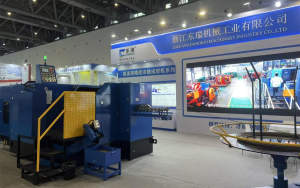
Dongrui Machinery Unveils Multi-Station Cold Heading Equipment at the 2026
 Skip to content

Many plants treat maintenance as a reaction to failure. A more reliable approach treats it as a system that protects both uptime and tool life. The guidance below is built for maintenance leads, production supervisors, and plant engineers who need a working framework rather than a theory. It moves from daily checks to root cause analysis and ends with how machine design itself changes the maintenance burden.
The fastest wins come from what an operator can see and hear at the start of a shift. A short daily routine prevents most acute failures.
Lubrication points should be verified first. Check oil levels at the cutoff, transfer, and knockout stations, and confirm the automatic lube system is actually delivering. A starved punch holder fails in minutes, not days.
Fastener torque on die holders, punch retainer nuts, and transfer cam bolts must be checked visually for looseness. Vibration works these loose over time, and a single missed torque check can let a die walk out of position.
Abnormal vibration and noise are the earliest warnings of bearing or gear trouble. Train operators to report any change in the machine’s sound profile, because a new tone today is often a seizure next week.
Safety devices are non negotiable. Verify the guards, light curtains, and emergency stops before production begins. A disabled safety circuit is both a compliance failure and a signal that shortcuts have entered the culture.
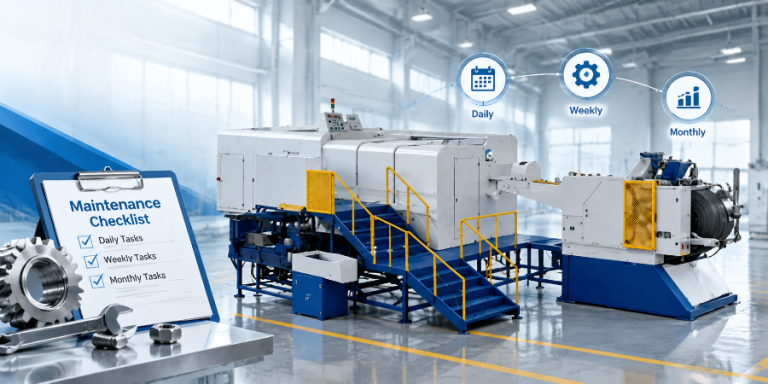
Preventive maintenance for a cold header should follow a fixed calendar so nothing is skipped under production pressure.
The transfer gear and feed mechanism need weekly inspection for wear and correct backlash. Misaligned transfer fingers cause double hits and bent parts, which then damage downstream tooling.
Bearings should be monitored monthly for temperature and play. A rising running temperature is a leading indicator of lubrication loss or contamination.
The clutch and brake assembly demands regular adjustment. Excessive slip wastes energy and generates heat that shortens lining life, while drag creates parts that are out of position at cutoff.
Electrical systems require a monthly check of contacts, relays, and control cabinet cooling. Heat inside the cabinet is the silent enemy of PLC and drive reliability.
Hydraulic contamination is often overlooked. Sample and inspect hydraulic fluid on a monthly basis, because abrasive particles accelerate wear in cylinders and valves faster than almost any other factor.
Cold forming troubleshooting begins with recognizing the defect, then tracing it backward to a cause.
Cracking at the head or under the head usually points to material issues such as improper wire annealing, excessive reduction in a single station, or worn die geometry that concentrates stress.
Burrs and flash most often come from worn cutoff knives, incorrect trim die clearance, or a slug that is oversized for the cavity.
Dimensional drift across a production run typically signals tool wear, inconsistently sized wire, or a press that is losing calibration at the main ram.
Sticking, where the part adheres to the punch or die, is generally a lubrication failure or a surface finish problem on the tool. Left alone, it produces scoring and then catastrophic tool breakage.
When a defect appears, work the diagnosis in a fixed order so you do not chase symptoms.
Start with a visual inspection of the part and the tooling. Confirm what the defect actually looks like and where on the part it occurs.
Move to the material specification. Verify wire grade, diameter tolerance, and surface condition against the drawing, because many failures trace back to incoming stock.
Examine the tooling next. Measure punch and die wear, check for chipping, and confirm the setup matches the process sheet.
Review lubrication delivery at each station. A blocked line or wrong viscosity explains a surprising number of sticking and cracking cases.
Check press calibration, including main ram stroke, knockout timing, and transfer position. Small timing errors compound into large quality swings.
Finally, pull the data logs. Modern headers record cycle counts, fault history, and sensor trends that often reveal when the drift began and what changed at that moment.
Extending tool life on a cold former depends on knowing when a tool is tiring, not waiting until it breaks.
A basic program tracks each punch and die by station, records part count at change, and notes the failure mode. Over time this shows the true wear curve for your specific parts and materials.
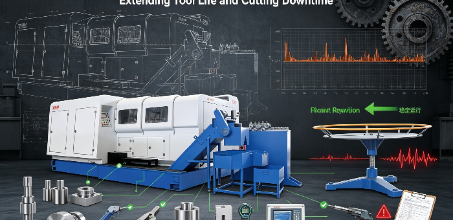
In line monitoring takes this further. Force sensors at the ram detect rising forging resistance as a die fatigues. Position sensors catch drift before it reaches the part. Temperature probes on bearings warn of lubrication loss. Vibration sensors identify imbalance long before a catastrophic failure.
The combination supports predictive replacement. Instead of changing tools on a fixed schedule or after a breakdown, you replace them when the data shows the wear window is closing. This protects both uptime and the cost of premature disposal.
The best maintenance plan fails without operator discipline. A clear SOP should define the correct startup and shutdown sequence, including pre lubrication, slow jog checks, and a controlled ramp to full speed.
Early warning recognition is a trainable skill. Operators who know the normal sound, heat, and part appearance will catch anomalies while they are still cheap to fix.
Avoiding overload is a cultural point as much as a technical one. Pushing a machine past its rated speed or reduction ratio to hit a short term number trades a few extra parts for cracked dies and a stalled line. The SOP must make the tradeoff explicit so the operator is not forced to choose between output and equipment health.
Maintenance burden is not only about how you run the machine. It is also set by how the machine is built.
A rigid cast bed absorbs forging shock instead of transmitting it through the structure. Less vibration means less loosening of fasteners, less bearing fatigue, and slower wear on the transfer system. Machines with a stiff, heavy frame tend to hold calibration longer between services.
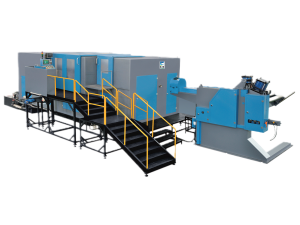
Dongrui‘s cold formers are engineered with this principle in mind. The DBP-136L part former uses a six station configuration rated at 140,000 kgf of forging force for bolts from 8 to 12.7 mm, while the DBHP-8 high speed cold former reaches up to 400,000 kgf for M8 parts at 350 pieces per minute. Both platforms are built for stable, high volume operation where structural rigidity directly reduces the day to day maintenance load.
Downtime is rarely caused by a single dramatic failure. It is the accumulated result of small checks missed, early warnings ignored, and tools run past their window. A disciplined cold heading machine maintenance program turns that pattern around by catching issues at the daily and weekly level, diagnosing defects with a structured workflow, and using monitoring to replace tools on evidence rather than guesswork.
Critical points should be verified every shift through the automatic lube system, with manual top ups as needed. The lubrication plan must match the machine’s duty cycle, because high speed lines consume oil faster than low volume setups.
The usual suspects are improper wire annealing, too much reduction in a single station, or worn die geometry that concentrates stress. Always verify material condition before adjusting tooling.
Track each tool by station and part count, monitor in line force and temperature, and replace tools predictively rather than on a fixed schedule. Consistent lubrication and correct reduction ratios matter as much as the steel grade of the tool.
Burrs typically come from worn cutoff knives, incorrect trim die clearance, or an oversized slug. Measuring the cutoff and trim setup against the process sheet resolves most cases.
It covers daily lube and torque checks, weekly transfer and feed inspection, and monthly bearing, clutch brake, electrical, and hydraulic contamination checks. A fixed calendar keeps the program from being skipped under pressure.
Explore the DBP-136L and DBHP-8 product pages for full specifications, or contact the Dongrui engineering team for a maintenance and throughput recommendation based on your part mix and annual volume.
Dongrui Machinery Unveils Multi-Station Cold Heading Equipment at the 2026
Reading time: ~8 min | Categories: Cold Forging Technology, Industrial
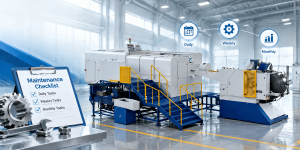
Table of Contents Introduction How to Use This Checklist Daily
1. Introduction If you’re in the market for a multi-station
 Optimized by Seraphinite Accelerator