Table of Contents Introduction What High-Speed Cold Forming Is and
 Skip to content
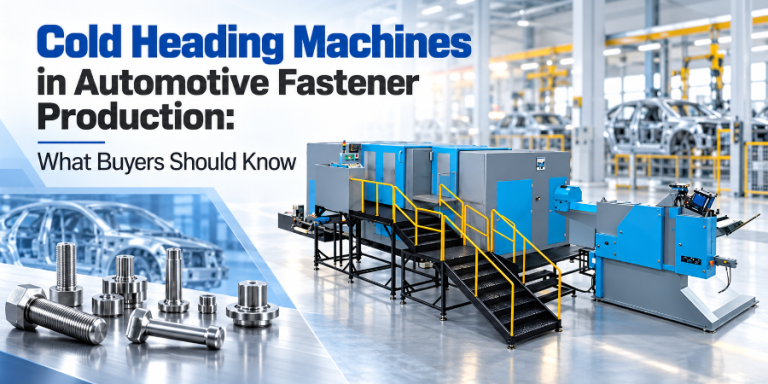
If you’re in the market for a multi-station cold heading machine, you’ve almost certainly run into the same fork in the road: do you go with a European brand like Hatebur or National Machinery — or do you take a serious look at what Chinese manufacturers now have to offer?
Ten years ago, the answer was simpler. Today, it’s genuinely complicated — and the right choice depends on factors that go well beyond the price tag on the quotation.
This guide breaks down the real differences between Chinese and European cold heading machines across five dimensions that matter most to fastener manufacturers: build quality, precision tolerances, after-sales support, total cost of ownership, and return on investment. By the end, you’ll have a clear framework for making the decision that’s right for your production floor.
Table of Contents
The global cold heading machine market was valued at approximately USD 3.9 billion in 2024 and is projected to grow to USD 5.4 billion by 2033. That growth is being driven largely by demand from automotive, EV battery, and aerospace supply chains — industries where precision and uptime are non-negotiable.
What’s changed in the last decade is that Chinese manufacturers — particularly those based in Zhejiang and Jiangsu provinces — have invested heavily in CNC machining centers, in-house tooling fabrication, and quality management systems that meet ISO 9001 and CE standards. The gap between the best Chinese machines and mid-range European equipment has narrowed significantly.
That said, the gap has not disappeared. Understanding exactly where it still exists — and where it no longer does — is the key to a smart purchasing decision.
European brands like Hatebur, SACMA, and National Machinery built their reputations on decades of precision engineering. Their machines are built to exceptionally tight tolerances and are designed for 20+ year service lives in high-volume production environments.
For many years, Chinese cold heading machines were built with a mix of domestically sourced and imported components — and the inconsistency in component quality was a legitimate concern.
What’s changed: Leading Chinese manufacturers now operate their own CNC machining centers and conduct in-house quality control throughout the production process, not just at final inspection. Key components — including crankshafts, dies, and main bearings — are manufactured to internationally benchmarked tolerances.
The honest bottom line: Top-tier Chinese manufacturers now produce machines that meet European benchmark tolerances for geometry, surface finish, and dimensional accuracy. Budget-tier Chinese assemblers — who source subcomponents externally and do not maintain in-house machining — do not. Country of origin matters far less than verifying the manufacturer’s in-house capability directly.
What to check: Request profiler scans of completed tooling, roughness test data from die surfaces, and hardness certificates for critical components before accepting any supplier’s tolerance claims.
European machines — particularly Hatebur’s COLDmatic and HOTmatic lines, and National Machinery’s FORMAX series — set the standard for ultra-high-speed forming and complex part geometries. If you’re producing aerospace fasteners or intricate automotive drivetrain components at tolerances below ±0.01mm, these machines were designed for exactly that application.
Chinese machines, including DONGRUI‘s 3- to 8-station progressive formers, are optimized for a wide range of standard and semi-complex fastener applications: bolts, screws, rivets, socket heads, and flange parts. At rated speeds — up to 450 pcs/min on M6 standard parts for a 6-station machine — they deliver consistent dimensional accuracy for the applications that represent the bulk of global fastener production volume.

The practical question isn’t “which is more precise overall” — it’s “which machine is precise enough for my specific parts?” For the majority of fastener manufacturers producing M4 to M24 range components, Chinese multi-station formers now meet the production specification without requiring European-level capital expenditure.
This is historically where Chinese manufacturers have had the weakest position — and it remains the dimension where the most due diligence is required.
European manufacturers typically offer global service networks, remote diagnostics, and in-region spare parts availability. National Machinery has dedicated technical support teams in North America and Europe. Hatebur offers remote maintenance and on-site repair services across multiple continents.
Chinese manufacturers vary widely. The best ones have invested in multilingual technical support teams, international spare parts logistics, video-guided remote troubleshooting, and structured warranty programs. The worst offer little beyond a WhatsApp number and a promise.
What to look for in a Chinese supplier:
DONGRUI, for example, maintains a YouTube channel with machine installation and operation content, provides a detailed English-language guidebook, and offers WhatsApp-based technical support for international customers.
Purchase price is a starting point, not a conclusion. The number that determines profitability over a machine’s working life is total cost of ownership (TCO), which includes:
Here’s a simplified comparison for a 6-station cold heading machine producing M8 bolts at approximately 250 pcs/min:
| Cost Factor | European Brand (Est.) | Chinese Tier-1 (Est.) |
|---|---|---|
| Purchase price | USD 400,000–700,000 | USD 80,000–180,000 |
| Annual maintenance | USD 15,000–30,000 | USD 8,000–15,000 |
| Spare parts availability | In-region stock | 3–7 days air freight |
| Typical service life | 20–25 years | 12–18 years |
| Energy efficiency | High (servo systems) | Moderate–high |
Note: These are illustrative ranges. Actual costs vary by model, application, and region. Always request itemized quotations and reference customer data before making capital decisions.
At a purchase price differential of USD 250,000–500,000, a fastener manufacturer producing 150 million parts per year at a margin of USD 0.003 per part recovers that differential in approximately 18–36 months — before accounting for maintenance and downtime differences.
Chinese machines tend to deliver stronger short-term ROI when:
European machines tend to justify their premium when:
Regardless of origin, apply the same due diligence framework:
The Chinese vs. European decision for cold heading machines is no longer a question of quality versus price. It’s a question of which performance tier your application actually requires, and which supplier — regardless of flag — can demonstrably deliver it.
For the majority of global fastener manufacturers producing standard and semi-complex components, top-tier Chinese manufacturers now offer machines that meet production requirements at a capital cost that allows for faster ROI, more flexible capacity expansion, and stronger competitiveness in price-sensitive markets.
For the minority of manufacturers operating at the absolute precision frontier — aerospace, automotive Tier-1, bearing production at ultra-tight tolerances — European machines remain the benchmark.
The key decision criterion isn’t where the machine was built. It’s whether the supplier can show you, in verifiable documentation, that their machine will hold your tolerance, run at your required speed, and be supported when something goes wrong.
DONGRUI has been manufacturing multi-station cold heading machines since 1989. Our equipment is ISO 9001 certified, CE marked, and installed across Southeast Asia, the Middle East, Europe, and the Americas. Contact us for a tailored quotation.
Table of Contents Introduction What High-Speed Cold Forming Is and
1. Introduction Walk into any fastener manufacturing facility and you
1. Introduction If you are planning to set up or
1. Introduction A finished bolt sitting in a bin looks
 Optimized by Seraphinite Accelerator