Table of Contents Introduction What Defines Standard vs Non-Standard Bolts
 Skip to content

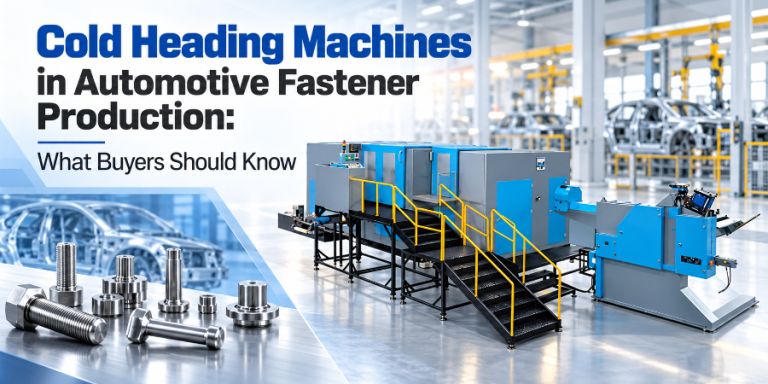

A bolt maker rarely struggles to find a cold heading machine. The harder problem is finding the one that actually fits. Shops scaling up from a manual cell, or switching their mix from M8 to M6 and back again, often face the same fork: a former that is too large ties up capital and floor space it will never use, while one that is too small tops out the day a big order lands. The cost of a wrong call shows up months later, in idle capacity or in jobs the line simply cannot take.
This guide works through the selection in the order a buyer should think about it. We start with what the machine does and which specifications decide the fit, then map the real models onto the M6 to M20 range, and finish with the mistakes that inflate cost and the setups that protect return on investment.
Cold heading builds the head and shank by upsetting and extruding wire at room temperature, so almost no material is removed. Thread rolling is a different, downstream step that forms the thread on the blank the header produced, and machining is the older route that cuts the shape out of bar, throwing off swarf with every pass. For high-volume bolt making, heading is the step that sets both the geometry and most of the material savings, which is why it sits at the front of the line.
Four numbers settle whether a former is right for a job. The applicable diameter range tells you which bolt sizes the tooling can hold. The station count shows how complex a shape the machine can build in one flow. The rated speed in pieces per minute sets the throughput ceiling. The maximum shank length decides how long a bolt the machine can form before the blank runs out of die.
For M6 standard parts at scale, the DBHP-6 high-speed cold former is built for the job. It runs across four, five, or six stations and reaches up to 450 pieces per minute on an M6 standard part, with an applicable bolt diameter of 3 to 6 mm. The compact footprint, about 4 by 1.6 by 1.8 meters, suits a shop that wants output without a large floor claim.
The DBHP-8 takes the next step up, covering bolts from 5 to 8 mm and reaching 350 pieces per minute on an M8 standard part across four to six stations. Its forging force of 400,000 kgf and a 7-ton-smaller sibling footprint than the larger part formers make it the natural choice when the main volume sits at M8.
In the 8 to 12 mm band, the DBF-134L produces standard bolts up to 160 mm in shank length at 75 to 110 pieces per minute. The DBP-136L covers the same diameter and length but is built for standard and non-standard bolts and parts, which matters when the catalog includes shaped or non-standard items the DBF-134L is not meant for.
For the upper end of the range, the DBP-206L six-station part former handles bolts from 12 to 20 mm in diameter with a maximum shank length of 220 mm. This is the machine to specify when the order book includes the heavy fasteners that the smaller formers cannot reach.
Most expensive mistakes come from a capacity mismatch. A shop that buys a 12 to 20 mm former to make M6 parts pays for force and frame it will never use, while a shop that buys an M8 former and then wins a 16 mm contract has no path forward. The second trap is assuming every former takes non-standard work; the DBF-134L is for standard bolts, so a non-standard mix needs the DBP series instead.
Tool-change loss is the quiet third cost. Every time the model changes, the line stops for setup, and that downtime erodes the saving the machine was meant to deliver. Floor-space footprint is the fourth, because a larger former that does not fit the bay forces a layout change the budget did not plan for.
The DBHP series and the DBF or DBP series are not rivals so much as different answers. The high-speed formers, DBHP-6 and DBHP-8, win on cost per piece and labor, because one operator watches several hundred parts a minute from a small frame. The part formers, DBF-134L and DBP-136L or DBP-206L, give up some speed but take larger diameters, longer shanks, and non-standard shapes that the compact machines cannot.
The right comparison is therefore not which is better but which matches the part. A line that makes one standard bolt all day should favor the high-speed former. A line that swings between sizes and shapes should favor the broader part former, because the lost speed is cheaper than the lost jobs.
A dedicated M6 or M8 standard-bolt line is the clearest fit for the DBHP series. Running at rated speed with one operator, it delivers the lowest cost per piece and the smallest footprint, which is exactly the profile a high-volume commodity fastener shop wants.
When the parts include flanged, collared, or otherwise non-standard bolts, the DBP-136L and DBP-206L take over. Their wider diameter and length range and their tolerance for non-standard shapes keep the line flexible without a second cell.
The choice between a longer-shank former and a multi-station one depends on the geometry. Extended-length models such as the DBF-134L at 160 mm or the DBP-206L at 220 mm suit long bolts where the shank is the constraint. Multi-station formers, four to six stations, suit parts whose head or body needs several forming steps, because building the shape in line removes secondary machining.
Return on a cold header comes from three habits. Run the machine at its rated cycle rather than below it, because the per-part cost only falls when the throughput is real. Invest in quick tool change, since shorter changeovers mean more of the day is spent making parts instead of setting up. Use the man-machine and space efficiency the machines are designed for, the efficient use of both manpower and floor space that the DBHP and DBP lines are built around, so one operator and a compact bay support the output.
The model locks in once you fix two variables: the bolt diameter you must cover and the output you must hit. M6 high volume points to the DBHP-6, M8 to the DBHP-8, 8 to 12 mm standard to the DBF-134L and non-standard to the DBP-136L, and 12 to 20 mm to the DBP-206L. Match those to your mix and the capacity question answers itself.
Zhejiang DongRui supplies this full range of high-speed and part-forming cold headers, covering bolt production from 3 mm up to 20 mm and built for efficient utilization of manpower and space. To confirm which model fits your diameter, length, and volume, explore the product range and request a quote with your part specifications.
The DBHP-6 offers four, five, or six stations. A standard hex head bolt needs only four stations, while five or six stations suit parts that require extra forming steps or tighter control. More stations add capability, not a requirement, for a simple M6.
It is the maximum rate stated for an M6 standard part under the machine specification. Actual output depends on the wire grade, lubrication, and setup, so a well-run line approaches it while a difficult material runs lower. Treat it as the ceiling, not a guarantee for every job.
The DBF-134L is specified for standard bolts in the 8 to 12 mm range. For non-standard bolts and parts in that diameter, the DBP-136L is the correct choice, because it is built for both standard and non-standard work.
The DBP-206L six-station part former covers bolts from 12 to 20 mm in diameter with a maximum shank length of 220 mm, which places it at the top of the M6 to M20 range addressed here.
Favor the part formers, the DBP-136L for 8 to 12 mm and the DBP-206L for 12 to 20 mm, because they accept non-standard shapes and a wider size band. The trade is lower speed, yet for mixed, low-volume work the flexibility beats the cycle rate, provided changeover is
Table of Contents Introduction What Defines Standard vs Non-Standard Bolts
1. Introduction If you’re in the market for a multi-station
Reading time: ~8 min | Categories: Cold Forging Technology, Industrial
1. Introduction A finished bolt sitting in a bin looks
 Optimized by Seraphinite Accelerator