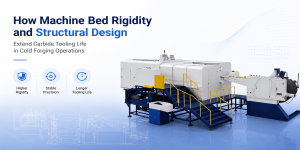
1. Introduction When a cold heading machine runs at 350–450
 Skip to content

The thread is one of the smallest features on a fastener, yet it carries a disproportionate share of the engineering risk. A thread that fails in fatigue brings down the whole joint, and a thread that costs too much to make erodes the margin on every part in the bin. For anyone specifying how a bolt or screw should be finished, the choice between rolling and cutting the thread is therefore not a detail. It is a decision that touches strength, surface quality, material use, and unit cost at the same time.
Thread rolling is a cold process. Two dies carrying a mirror image of the thread profile press against a rotating or advancing blank and squeeze the surface metal into shape. The material is displaced, not removed, so the thread rises from the existing stock instead of being carved out of it.
The method depends on preparing the blank to the correct diameter, because the thread form is generated by flow rather than by subtraction. When the blank pitch diameter is right, the rolled thread emerges with the grain of the steel bent to follow the contour of the flank and root. That continuity is the single feature that explains most of the performance advantage later on.
Thread cutting takes the opposite route. A single point tool or a threading die removes material to open up the groove of the thread, producing swarf with every pass. The geometry is accurate and the setup is familiar, which is why cutting remains common for low-volume and non-standard work.
The cost of that familiarity is material lost as chips and a grain structure that is severed at the thread root. For many applications that trade is acceptable, but it becomes harder to justify as volumes rise and as the fastener moves into a fatigue-critical joint.
The reason rolled threads are stronger rests on what happens to the metal’s internal grain. Rolling bends the grain to follow the thread contour, so the fiber runs unbroken around the root where stress concentrates. Cutting interrupts that fiber with the tool edge, leaving a root that is effectively notched from a metallurgical standpoint.
Measured results are consistent across the industry: rolled threads typically show roughly 20 to 30 percent higher fatigue strength than cut threads of the same size and material. The rolling action also leaves the surface in compression, which resists the crack growth that drives fatigue failure. When a fastener lives in a vibrating or cyclically loaded joint, that margin is what keeps it in service.
Because rolling burnishes the flank as it forms it, the resulting surface is smooth and work-hardened rather than scored by a cutting edge. The improved finish gives a better fit against the mating thread, lowers the friction scatter during tightening, and reduces the paths that corrosion can follow into the part.
Cut threads, by comparison, carry the tool marks of the process. Those marks are not fatal, yet they act as starting points for wear and crack initiation. For fasteners that are assembled and reassembled, or that sit in harsh environments, the rolled finish is the more durable choice.
Cold thread rolling fasteners gain a second advantage that is easy to overlook on the drawing but obvious on the shop floor. Rolling produces essentially no chip, because nothing is removed. Thread cutting throws off swarf equal to roughly 15 to 25 percent of the thread volume, depending on the profile and the depth of cut.
On a mild steel part that loss is annoying. On an expensive alloy it is a direct hit to the bill of materials. Because the rolled thread is formed from the blank that is already there, the material you buy is the material you ship, minus only the small allowance taken at cutoff.
Throughput follows the same logic. An in-line thread rolling station commonly processes 20 to 60 parts per minute, and purpose-built machines run faster still on small standard threads. The operation is short, repeatable, and needs little operator attention once set.
Thread rolling cost savings accumulate from three directions at once: no material lost to chips, a high and steady cycle rate, and minimal tool wear compared with a cutting edge that is constantly removing metal. For a production run measured in the hundreds of thousands, the per-part gap between the two methods is large enough to decide which process a plant should standard on.
Rolling is not universal. Very low volumes do not always justify the tooling, and threads on already hardened stock are usually cut because the metal is too hard to displace. Unusual profiles, very large diameters, and one-off repair work also fall outside the sweet spot of rolling.
The sensible rule is to roll by default for standard high-volume threads and cut when the geometry, the hardness, or the order size makes rolling impractical. The two processes are complements, not rivals, and a flexible shop keeps both available.
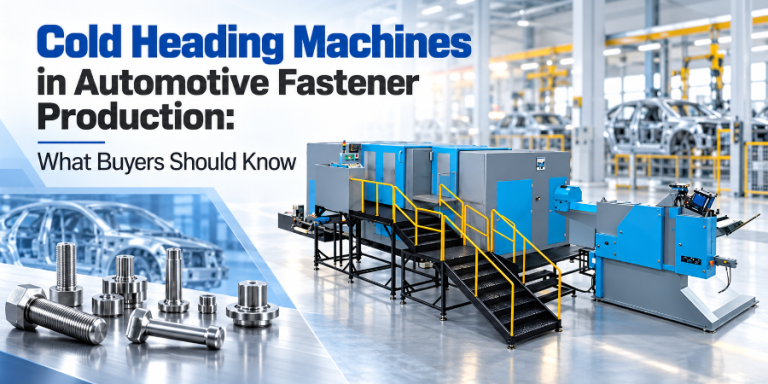
In a modern fastener line, thread rolling is the downstream partner of cold heading. The former upsets and extrudes the wire into a headed blank at several hundred parts per minute, and the roller then adds the thread in line before the part is ejected. Together they let a plant improve thread strength through cold forming while also keeping material waste near zero.
This pairing is the reason cold heading and thread rolling are usually discussed in the same breath. The heading step delivers the net-shape blank; the rolling step delivers the strong, low-cost thread. Neither alone captures the full economy, which is why the two are planned as one continuous process rather than as separate operations.
The case for rolling rests on measurable facts. Rolled threads keep the grain continuous through the root, which lifts fatigue strength by roughly 20 to 30 percent, and they do it with almost no material lost and a high, repeatable cycle rate. Cutting stays useful for hard, odd, or low-volume threads, but for the standard fastener that fills most bins, rolling is both the stronger and the cheaper route.
Usually not. Rolling is performed on material in the soft or lightly worked state, and the process itself work-hardens the surface. Threads needed on hardened parts are normally cut instead.
The headline gain is fatigue life, where rolled threads run roughly 20 to 30 percent ahead of cut ones. Static tensile strength is similar, so the advantage shows up where the joint sees repeated load.
The blank diameter must be held close to the thread pitch diameter, because the metal is displaced rather than removed. Accurate cutoff and consistent wire are what make the rolled thread come out to size.
Mostly for standard small to medium threads, where rolling is both fast and strong. Very large diameters or very fine non-standard forms may still be cut.
Yes. Many plants install it inline after the heading operation, which is exactly how the cold heading and rolling steps are combined on high-volume fastener programs.
Zhejiang DongRui supplies a range of high-speed cold formers suited to this work, including the DBHP-6 at up to 450 parts per minute for M6 parts, the DBHP-8 at 350 parts per minute for M8, and the DBF-134L for bolts from 8 to 12 mm in diameter at 75 to 110 parts per minute. Explore the full product range and request a quote to see how a high-rate cold former would pair with your rolling operation.
1. Introduction When a cold heading machine runs at 350–450
Table of Contents Introduction What Is Cold Forging and Why
Table of Contents Introduction Why NEV is the fastest-growing market

Table of Contents Introduction How to Use This Checklist Daily
 Optimized by Seraphinite Accelerator