1. Introduction If you are planning to set up or
 Skip to content
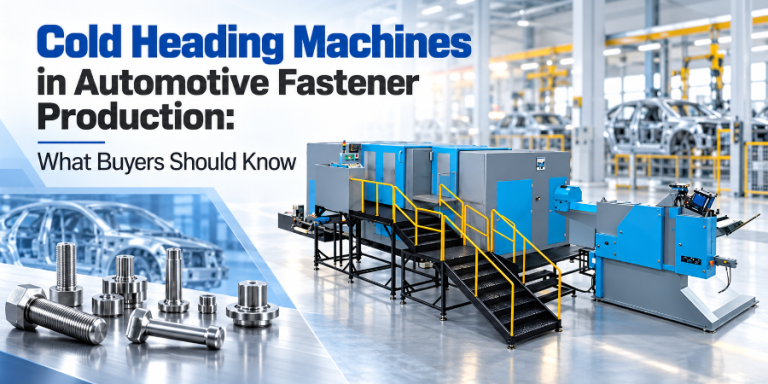
A single M6 engine bolt may look identical to one produced for general hardware, but the difference lies in what you cannot see: the dimensional tolerance band is up to five times tighter, the statistical process capability must meet IATF 16949 thresholds, and the material must survive heat treatment to Grade 8.8 or 10.9 property classes without failure. In automotive manufacturing, a fastener is not just a connecting element — it is a safety-critical component whose failure can trigger recall campaigns costing millions.
This places extraordinary demands on the cold heading machines that produce these fasteners. A progressive cold former must maintain dimensional repeatability across tens of thousands of parts while running at 350–450 pieces per minute. The machine must hold die alignment under repeated impact loads, transfer blanks between stations with micron-level positional accuracy, and produce parts that pass inline inspection without manual intervention.
This guide examines how high-speed progressive cold formers achieve the precision that automotive fastener manufacturing demands — covering tolerance requirements, Cpk and statistical process control (SPC), tooling strategies, material selection (including 10B21 boron steel), and quality inspection integration. Whether you are setting up a new automotive fastener line or auditing your current equipment’s capability, this article provides the technical framework to evaluate whether your cold formers are up to the task.
Table of Contents
The automotive industry operates under a quality framework that is among the most stringent in manufacturing. Three regulatory pillars define what “acceptable” means for automotive fasteners:
IATF 16949 is the global automotive quality management system standard, developed by the International Automotive Task Force. It supersedes ISO/TS 16949 and is mandatory for any supplier producing fasteners for major OEMs including Volkswagen, Ford, Stellantis, BMW, and Mercedes-Benz. The standard requires documented process control, risk assessment (FMEA), and statistical capability evidence for every characteristic identified as special or safety-critical in the control plan.
Before any fastener enters series production for an automotive customer, the supplier must submit a PPAP package. This includes dimensional layout reports, material certificates, capability studies, and initial process performance data. The PPAP submission demonstrates that the production process — including the cold heading machine, tooling, and material — is capable of consistently producing parts within specification. PPAP approval is granted per part number, and any change to the process (new die, different steel supplier, machine modification) may require a new submission.
Automotive fastener drawings typically specify tolerances that are significantly tighter than general industrial fasteners:
| Dimension | General Industrial | Automotive Grade |
|---|---|---|
| Head diameter | ±0.10mm | ±0.05mm or tighter |
| Shank diameter | ±0.05mm | ±0.02mm |
| Under-head squareness | ±1° | ±0.5° |
| Body length | ±0.15mm | ±0.05mm |
These tolerances are not optional — they are embedded in the part drawing and verified during PPAP. A cold former that cannot consistently hold ±0.02mm on the shank diameter will fail capability studies and cannot be approved for automotive production.
Cold heading machines produce a wide range of automotive fasteners, each with specific forming challenges:
The common thread across all these part types: the cold former must produce them at high speed, with tight dimensional control, and with metallurgical integrity that survives subsequent heat treatment. A part that looks correct dimensionally but has internal cold shuts or surface cracks will fail in service.
In automotive manufacturing, dimensional correctness is not verified by inspecting every part — it is verified by demonstrating that the process itself is statistically capable of producing within specification. This is where Cpk (Process Capability Index) becomes the critical metric.
Cpk measures how well a process produces output within specification limits, accounting for both variation (spread) and centering (how close the process mean is to the specification midpoint). The formula is:
Cpk Formula
Cpk = min[(USL − μ) / 3σ, (μ − LSL) / 3σ]
Where USL = Upper Specification Limit, LSL = Lower Specification Limit, μ = process mean, σ = process standard deviation (within-subgroup).
Under IATF 16949 and AIAG (Automotive Industry Action Group) guidelines, the minimum Cpk depends on the characteristic’s classification:
| Characteristic Class | Minimum Cpk (Series) | Minimum Cpk (PPAP Initial) | Defect Rate |
|---|---|---|---|
| Standard (routine) | ≥ 1.33 | ≥ 1.67 | ~63 ppm |
| Special / safety-critical | ≥ 1.67 | ≥ 1.67 | ~0.6 ppm |
What this means for a cold heading operation: during PPAP submission, the supplier must collect a minimum of 30 (preferably 100+) consecutive parts from the cold former, measure each critical dimension, and calculate Cpk. If the shank diameter on an M6 automotive bolt has a specification of ±0.02mm and the cold former produces parts with a standard deviation of 0.005mm, the Cpk would be approximately 1.33 — barely meeting the series threshold. To reach 1.67 (required for safety-critical features at PPAP), the standard deviation must be reduced to approximately 0.004mm or better.
This level of capability does not happen by accident. It requires a cold former with rigid machine structure, precise die alignment, consistent material feed, and stable tooling — all of which are design features of the machine, not operator adjustments.

Achieving Cpk ≥ 1.67 at 350–450 pcs/min requires more than a well-made die. The cold former’s structural and mechanical design determines whether precision can be sustained over long production runs. Here are the key systems that make it possible:
Every forming blow transmits force through the ram, through the die, and into the machine bed. If the bed deflects — even by a few microns — the die alignment shifts, and the part geometry changes. High-quality cold formers use heavy cast iron or ductile iron beds that have been aged to relieve internal stress, providing a stable platform that resists deflection under repeated impact. The ram is guided by precision-machined gibs or linear guides with minimal clearance, ensuring that the punch enters the die concentrically on every stroke.
In a multi-station cold former, the blank is transferred from one die station to the next by transfer fingers or cam-driven ejector mechanisms. The positional accuracy of this transfer directly affects the part: if the blank is misaligned by 0.1mm when inserted into the next die, the subsequent blow will produce a part with eccentricity or head offset. Modern cold formers use servo-driven or precision cam-driven transfer systems with positional repeatability measured in hundredths of a millimeter.
The punch and die must be concentric and co-axial on every stroke. Premium cold formers incorporate adjustable die holders with micrometer-level alignment capability, allowing the die-setter to dial in concentricity during setup. Once set, the alignment must be maintained — which is where the machine bed rigidity and ram guidance system come back into play. Any wear in the ram bushings or gib ways will cause progressive misalignment over a production run.
Advanced cold formers now integrate piezoelectric load sensors at each forming station, measuring the actual forging force in real time. If the load deviates from the established baseline — indicating a worn die, cracked insert, or material variation — the system flags the anomaly and can automatically scrap the affected part or stop the machine. This is one of the most effective tools for maintaining Cpk over long runs: instead of discovering dimensional drift at the next inspection, the machine detects the process change as it happens.
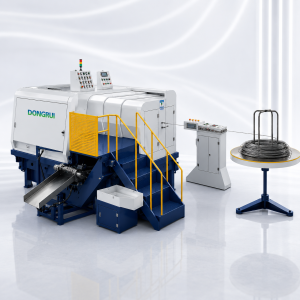
The Dongrui DBHP-6 High-Speed Cold Former exemplifies these design principles. With a 300,000 kgf forging force, 4/5/6-station configurability, and a 15kW main motor driving up to 450 pcs/min for M6 standard parts, it provides the structural rigidity and station flexibility needed for automotive-grade fastener production. The 7-ton machine weight and integrated die-pitch precision of 60mm ensure dimensional stability even at maximum output rates.
For larger automotive fasteners (M8 range, such as wheel bolts or structural fasteners), the DBHP-8 extends the same capability with 400,000 kgf forging force, 350 pcs/min output, and a heavier 12-ton frame — providing the additional rigidity needed to maintain precision on larger-diameter parts.
In automotive cold heading, the tooling is as critical as the machine. A precision cold former with worn or inadequate dies cannot hold Cpk 1.67 — regardless of how rigid the machine bed is. Here is what automotive-grade tooling requires:
Tungsten carbide is the standard die material for automotive cold heading. Carbide grades are selected based on the part material, deformation level, and production volume. For boron steel fasteners, a sub-micron carbide grade with cobalt binder content of 10–15% provides the best balance of wear resistance and toughness. Carbide dies typically outlast tool steel dies by a factor of 10–50x in cold heading service, making them the only economically viable option for automotive volumes.
To further extend die life and reduce galling (material adhesion to the die wall), carbide dies are often coated with PVD (Physical Vapor Deposition) coatings:
In automotive production, die life is not just a cost factor — it is a quality factor. As a carbide die wears, the part dimensions drift. A die that produces parts at the lower specification limit when new may produce parts outside specification after 50,000 hits if the wear is not monitored. Best practices for automotive die life management include:
The material fed into the cold former determines both how well the part forms and what mechanical properties it achieves after heat treatment. For automotive fasteners, the dominant material choices are boron steels and micro-alloyed steels, selected for their unique combination of cold formability and post-heat-treatment strength.
10B21 (SAE designation) is the most widely used steel grade for automotive fasteners up to Grade 8.8 and 9.8. Its composition is deceptively simple:
| Element | Content (%) | Role |
|---|---|---|
| Carbon (C) | 0.18–0.23 | Low carbon → excellent cold formability |
| Manganese (Mn) | 0.70–1.00 | Improves hardenability and strength |
| Boron (B) | 0.0005–0.003 | Trace boron dramatically increases hardenability after quench |
| Silicon (Si) | ≤0.10 | Kept low to maximize cold heading plasticity |
The “boron effect” is what makes 10B21 remarkable: a trace amount of boron (as little as 0.0005%) increases the steel’s hardenability to a degree that would otherwise require significant additions of expensive alloying elements like chromium, nickel, or molybdenum. This means the steel is soft and ductile during cold heading (because of its low carbon content), but after quenching and tempering, it achieves the tensile strength required for Grade 8.8/9.8 fasteners — at a fraction of the material cost of alloy steel.
10B21 is supplied as CHQ (Cold Heading Quality) wire, spheroidized annealed to minimize yield strength and maximize ductility. The wire surface is pickled and phosphated to provide a lubricant-carrying layer for the cold heading process.
For Grade 10.9 fasteners (typically M8–M12 engine and structural bolts), 15MnB (or equivalent 20MnB5 in DIN designations) is commonly used. This grade has higher carbon and manganese content, providing greater hardenability. However, the higher carbon also makes cold heading more challenging — requiring more forming stations and higher forging force to avoid cracking during heading.
For Grade 12.9 fasteners (the highest standard grade), medium carbon alloy steels such as 42CrMo (DIN 1.7225) or SCM435 (JIS) are used. These materials are significantly harder to cold form and may require warm heading (heating the wire to 400–600°C to reduce flow stress) or a 5- or 6-station progressive forming strategy that distributes deformation across more blows.
In an automotive fastener production line, quality inspection is not a post-production step — it is integrated into and immediately after the cold heading process. The goal is to detect process drift before it produces nonconforming parts that reach the customer.
Modern cold heading lines can integrate laser or contact-type inline gauging at the knockout station, measuring critical dimensions (typically shank diameter and body length) on every part or on a sampled basis. The gauging data feeds directly into SPC software, updating Cpk calculations in real time. If the Cpk trends downward — indicating the process is shifting — the system generates an alert before parts go out of specification.
Machine vision cameras inspect each fastener for surface defects that dimensional gauging cannot detect: head cracks, cold shuts, die-fill impressions, and surface scoring. These defects are particularly critical in automotive applications because they can act as stress concentration points that initiate fatigue failure in service. Vision systems can be trained on known defect types and will reject parts that match the defect signature.
After thread rolling, automotive fasteners pass through go/no-go thread gauging and, for critical applications, optical thread profile inspection that verifies thread pitch, flank angle, and major/minor diameter simultaneously. These measurements feed back into the overall process capability record required for IATF 16949 compliance.
As mentioned earlier, real-time forging load monitoring at each station is one of the most powerful quality tools available. Systems using piezoelectric sensors measure the actual forming force on every blow and compare it to the established process window. Key capabilities include:
Together, these inspection and monitoring systems form a closed-loop quality framework that makes automotive Cpk compliance achievable and sustainable over long production runs — not just during PPAP submission, but throughout the life of the production contract.
Under IATF 16949 and AIAG guidelines, the minimum Cpk depends on the characteristic classification. For standard (routine) characteristics, Cpk ≥ 1.33 is required during series production, with Cpk ≥ 1.67 expected during PPAP initial submission. For safety-critical or special characteristics (identified in the control plan or FMEA), Cpk ≥ 1.67 is required at all times — both at PPAP and during ongoing production. A Cpk of 1.33 corresponds to approximately 63 defective parts per million, while 1.67 reduces this to approximately 0.6 ppm. These requirements are not optional — they are contractual conditions in automotive supply agreements. Contact Dongrui’s engineers to discuss your Cpk targets and machine capability.
Yes, but only with the right combination of machine, tooling, and material. Achieving ±0.02mm on a shank diameter requires: a cold former with rigid machine bed and precise ram guidance to prevent die deflection under load; carbide dies with appropriate wear-resistant coatings (TiN or TiAlN) to minimize dimensional drift; CHQ-grade wire with consistent diameter and surface preparation; and real-time load monitoring to detect process changes before they affect dimensions. A well-maintained multi-station cold former with these features can sustain Cpk ≥ 1.67 on critical automotive dimensions — but the capability must be verified through PPAP capability studies, not assumed.
Scrap rates in automotive cold heading vary widely depending on the part complexity, material, and process maturity. For a well-established production line producing standard automotive bolts from 10B21 boron steel, scrap rates of 0.5–2% are typical, with startup scrap during die changeover adding to the average. Safety-critical fasteners may have tighter acceptance criteria that push scrap rates higher. The key to minimizing scrap is not just the machine — it is the process control system (inline gauging, load monitoring, SPC) that detects drift before parts go out of specification.
The most common grades are 10B21 boron steel for Grade 8.8/9.8 fasteners (the majority of automotive bolts), 15MnB (or 20MnB5 in DIN) for Grade 10.9, and 42CrMo / SCM435 alloy steel for Grade 12.9. Boron steel is preferred because its trace boron content (0.0005–0.003%) provides hardenability equivalent to much more expensive alloy steels, while maintaining the low-carbon ductility needed for high-speed cold heading. The steel is supplied as CHQ (Cold Heading Quality) wire, spheroidized annealed and phosphated for optimal formability.
Safety-critical fasteners (e.g., engine head bolts, wheel bolts) require a multi-layered approach: (1) 5- or 6-station configuration to distribute deformation across more blows, reducing per-station stress and avoiding internal defects; (2) carbide tooling with PVD coatings to maintain dimensional consistency over long runs; (3) real-time load monitoring at every station to detect anomalies before they produce nonconforming parts; (4) inline gauging and vision inspection immediately after forming; and (5) documented process control (SPC with Cpk trending) that meets IATF 16949 and PPAP requirements. The Dongrui DBHP-8, with 4/5/6-station flexibility and 400,000 kgf forging force, is designed to meet these requirements for M8-range automotive fasteners.
Automotive fastener manufacturing is not simply “cold heading with tighter tolerances” — it is a system-level discipline that demands precision at every stage: the machine structure, the tooling, the material, the process control, and the inspection methodology. Here is the framework for achieving automotive-grade production:
Dongrui, as a National High-Tech Enterprise and cold forging machine manufacturer with exports to 145+ countries, provides the multi-station cold formers that automotive fastener producers rely on. From the high-speed DBHP-6 to the heavy-duty DBHP-8, our machines are engineered for the dimensional precision, structural rigidity, and station flexibility that automotive-grade production demands.
Building an Automotive Fastener Production Line?
Tell us your fastener specifications, material grade, and target Cpk. Our engineers will recommend the optimal machine configuration and tooling strategy for your automotive production requirements.
Dongrui Equipment (Zhejiang DongRui Machinery Industry Co., Ltd.) is a National High-Tech Enterprise specializing in cold heading machines and multi-station cold formers. Products are exported to 145+ countries including India, Turkey, Russia, Brazil, and Southeast Asia. Visit our website for product specifications and quotations.
1. Introduction If you are planning to set up or
1. Introduction When you manage a high-volume fastener plant or
Table of Contents Introduction What property classes mean The quench
1. Market Growth and Scale In 2026, the global cold
 Optimized by Seraphinite Accelerator