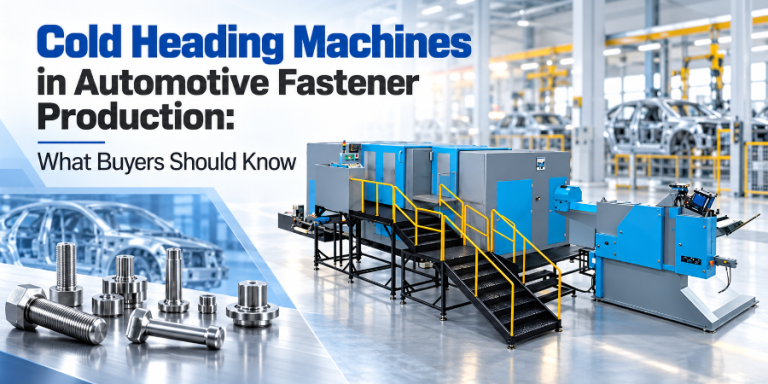
Cold heading equipment is widely used in the machinery industry for the manufacturing of various components, proving especially suitable for processing key parts such as shafts and gears.
In the production of shaft parts, the cold heading process utilizes plastic deformation of metal billets to precisely control diameter and length dimensions while ensuring consistency in surface quality. Furthermore, in the manufacturing of gear parts, cold heading technology is employed to form the tooth profiles, thereby enhancing the strength and wear resistance of the gears. This process not only reduces the workload for subsequent machining but also significantly improves material utilization. For example, studies indicate that gear parts produced via cold heading can achieve a material utilization rate more than 20% higher than those made using traditional cutting methods. Therefore, the application of cold heading equipment in the machinery industry extends beyond the production of simple fasteners to the manufacturing of more complex mechanical components.
The application of cold heading equipment in the machinery industry offers significant technical advantages, particularly in improving component dimensional accuracy, surface quality, and enhancing the performance of mechanical products.
Precision Control: First, through high-precision die design and optimized process parameters, the cold heading process achieves micron-level dimensional control, meeting the machinery industry’s demand for high-precision parts.
Enhanced Strength & Toughness: Second, during the cold heading process, the metal billet undergoes plastic deformation, which refines its internal grain structure. This significantly enhances the strength and toughness of the components. This characteristic makes cold heading particularly suitable for manufacturing high-strength mechanical parts.
Superior Surface Finish: Additionally, cold heading effectively improves the surface quality of components, reducing the need for subsequent surface treatment processes such as polishing or coating, thereby lowering production costs.
Technical Benchmark: Research shows that mechanical parts manufactured using the cold heading process can achieve a surface roughness of less than Ra 0.8μm, a standard far superior to that of traditional machining processes. These advantages not only enhance the overall performance of mechanical products but also bring significant economic benefits to enterprises.
 Skip to content