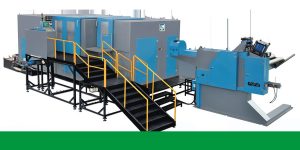
Table of Contents Introduction What property classes mean The quench
 Skip to content
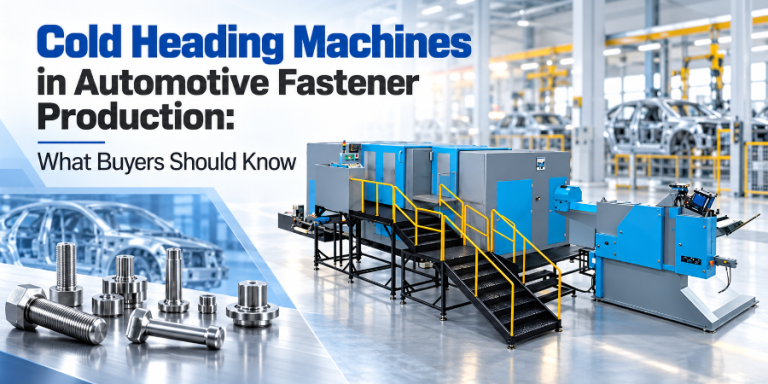
Reading time: ~8 min | Categories: Cold Forging Technology, Equipment Selection Guide
Selecting the right cold forging machine is not just about choosing a brand—it is about matching your machine’s capabilities to the geometry of your parts. A common mistake in industrial fastener manufacturing is over-specifying or under-specifying the number of stations, both of which erode profitability.
Whether you need a simple 3-station setup for standard bolts or a complex 7-station system for automotive pins, understanding the relationship between station count and part complexity is essential. Here is how Dongrui’s engineering team helps you choose the perfect multi-station cold forging machine for your specific production needs.
Table of Contents
A 3-station cold header is the workhorse for simple, high-volume production. It is ideal for parts requiring basic upsetting and heading operations. If your production portfolio consists of standard screws, rivets, or basic pins, this configuration provides the fastest ROI and lowest operational complexity.

The 5-station configuration strikes a balance between simplicity and versatility. By adding two extra stages, manufacturers gain the ability to perform extrusion and trimming in a single pass. This is often the preferred choice for cold forging machine for automotive parts that require mid-level complexity, such as stepped shafts and hollow-headed fasteners.
For parts that require intricate internal geometries, piercing, or multiple extrusion steps, 7-station machines are the industry benchmark for “net-shape” capability. These machines allow engineers to distribute forming forces over more stations, which significantly increases tool life and improves the surface quality of the final part.
Choosing the right configuration comes down to three factors:
With 30 years of manufacturing expertise, Dongrui doesn’t just sell machines; we analyze your part drawings to suggest the optimal station count. We ensure your Dongrui cold forging equipment is perfectly calibrated to your specific geometric requirements.
Generally, no. The machine frame and transfer system are designed for a specific number of stations. It is much more cost-effective to invest in the right station count from the start.
More stations allow for “progressive forming,” where the metal is deformed in smaller increments, which reduces strain on the material and extends the life of your dies.
Whether you choose 3, 5, or 7 stations, the goal is always to achieve net-shape manufacturing with the highest efficiency. If you are unsure which setup fits your business, leverage our 30 years of manufacturing expertise to build a production line that scales with your growth.
Which Station Setup Do You Need?
Send us your part drawings. Our engineering team will perform a station-count analysis and recommend the most cost-effective solution.
Table of Contents Introduction What property classes mean The quench
Reading time: ~9 min | Categories: Cold Forging Technology, Industrial
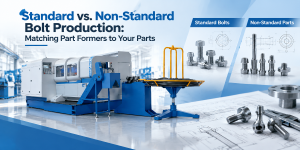
Table of Contents Introduction What Defines Standard vs Non-Standard Bolts
Reading time: ~8 min | Categories: Cold Forging Technology, Industrial
 Optimized by Seraphinite Accelerator