Introduction
As a critical component in the field of electrical connectivity, copper terminal lugs (often referred to as “copper noses”) are extensively utilized across several key sectors. In electrical connections, they serve as the interface between cables and equipment, minimizing issues such as poor contact and loosening to ensure efficient current transmission and stability. Their application is equally indispensable in power transmission. Cable connections in high-voltage transmission lines typically rely on terminal lugs to achieve efficient conductivity. For instance, in connections between substations and distribution networks, they not only provide stable electrical contact but also effectively reduce energy loss, thereby enhancing power transmission efficiency. Furthermore, in the renewable energy sector—such as wind and solar power systems—terminal lugs are used to connect generators to inverters, ensuring the efficient transfer of electricity from generation equipment to the grid. These applications fully demonstrate the significant status and broad versatility of copper terminal lugs in modern power systems.
Traditional Production Steps
In the traditional production workflow of copper terminal lugs, the first stamping machine is tasked with processing copper material into copper tubes. This is achieved by plastically deforming the copper material through dies to form a tubular structure. Based on the fundamental theories of metal stamping, the copper material is first placed in a feeding device, positioned, and then enters the stamping area. Subsequently, the upper die descends, forcing the copper material into a pre-designed cavity to complete the initial tubular forming.
After the copper tube is manufactured, the semi-finished product must be transferred to a second stamping machine to press the flattened section for the terminal connection. This is another critical step in the production process. At this stage, the copper tube is repositioned and fixed. A punch moves downward from the center of the tube, applying high pressure to induce local plastic deformation, ultimately forming the shape required for electrical connections.
Analysis of Traditional Production Methods
Although traditional stamping processes are widely used, their inherent limitations regarding efficiency, resource consumption, and space occupation are particularly evident. From an efficiency standpoint, the traditional method requires two independent stamping machines to separately complete tube forming and subsequent stamping/punching. This step-by-step operation inevitably extends the production cycle.
Furthermore, traditional methods demand significant human resources, especially during the transfer of semi-finished products and secondary positioning. This often requires multiple workers collaborating, which not only increases labor costs but also introduces potential quality fluctuations due to human error. In terms of space, two stamping machines and their auxiliary devices (such as unloaders and inspection tables) occupy a large amount of workshop floor space, resulting in low site utilization. Additionally, the long material transfer paths between equipment further reduce the compactness and flexibility of the production layout. These issues indicate that traditional methods struggle to meet modern manufacturing demands for high efficiency, low cost, and flexibility, creating an urgent need for technological innovation.
Dongrui 6-Station Cold Heading Forming Method
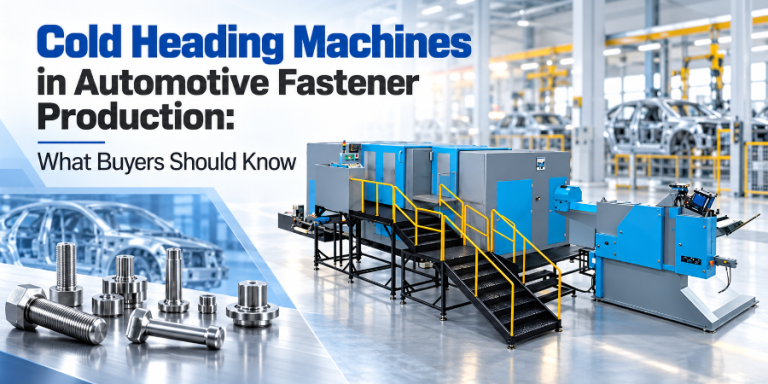
In the Dongrui 6-station cold heading machine, copper material is first fed into the first station for initial pressing. It then passes sequentially through multiple stations for continuous processing, finally forming a copper tube that meets dimensional requirements. During this process, the equipment utilizes high-precision die design and advanced control systems to ensure the inner/outer diameter precision and wall thickness uniformity of the tube.
The key to the success of this production method lies in the Clamp Flipping Technology, a core technology of Dongrui cold heading machines. This technology allows the clamps, which operate on a horizontal system, to flip during the transmission process, thereby altering the position of the gripped workpiece. This enables the production of specific products that are unachievable with traditional cold heading processes.
After the copper tube is pressed and formed, the clamping mechanism automatically grabs the semi-finished product from the previous station and flips it to a designated angle via a preset program, preparing it for the next process. Through this mechanism, complex procedures found in traditional manufacturing—such as manual collection of semi-finished products and centralized unloading—are achieved simply through the “release and grip” action of the clamps between two cold heading stations. This significantly saves on labor consumption and improves production efficiency, truly delivering “one-touch production” to customers.
Moreover, the advantages of clamp flipping technology are also reflected in product protection. By avoiding surface scratches or deformation caused by multiple handling steps in traditional methods, this technology significantly enhances the surface quality and overall performance of the finished product. More importantly, the introduction of this technology opens up more possibilities for manufacturing other high-difficulty irregular parts on cold heading equipment.
Conclusion
The success of the copper terminal lug project on Dongrui cold heading equipment demonstrates that the prospects for cold heading technology are vast. It can replace outdated production methods in many industries, facilitating high-efficiency, low-cost production solutions. Underpinning all of this is Dongrui’s dedication to using innovation to solve problems for customers. Whenever customers have a need, our technical team strives to help them achieve their goals, assisting their businesses in reaching new heights.
 Skip to content