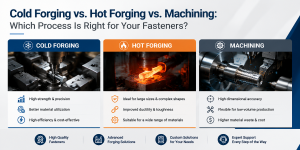
1. Introduction Every fastener manufacturer faces the same fundamental question:
 Skip to content
For decades, “Made in China” in the machinery sector carried a simple association: low cost, acceptable quality, and limited after-sales support. Fastener producers in India, Turkey, Brazil, and Southeast Asia bought Chinese cold heading machines primarily because the price was right — and accepted the trade-offs in precision, durability, and technical support as part of the deal.
That picture is outdated. China’s cold heading machine industry has undergone a fundamental transformation over the past decade. According to data from the China General Machine Components Industry Association, the domestic brand market share in China’s cold heading machine market grew from 35% in 2018 to 65% in 2025, with the total market reaching 12 billion yuan. Domestic machines now achieve production speeds exceeding 500 pieces per minute, dimensional precision within ±0.02mm, and scrap rates below 0.3% — figures that place them at the level of international first-tier brands.
This article examines why global fastener producers are increasingly sourcing cold heading machines from China — not just for price, but for engineering capability, product quality, and after-sales infrastructure. We cover the industry’s evolution, the credentials that distinguish qualified manufacturers from low-end producers, a total cost of ownership comparison framework, and a practical verification checklist for buyers evaluating Chinese suppliers.
Table of Contents
China’s cold heading machine industry began in the late 1950s, initially using equipment imported from the former Soviet Union. For decades, the country remained dependent on imported high-end cold forming equipment — a gap that restricted the fastener industry’s ability to compete in high-value-added segments. European manufacturers (National Machinery, Hatebur, Sacma) and Japanese brands dominated the premium market, while Chinese producers competed primarily on price in the low-to-mid segment.
The turning point came through sustained R&D investment and national manufacturing transformation policies. The results are measurable:
| Metric | 2018 Level | 2025 Level |
|---|---|---|
| Domestic brand market share (China) | 35% | 65% |
| Production speed (pcs/min) | ~200 | 500+ |
| Dimensional precision | ±0.05mm | ±0.02mm |
| Scrap rate | ~1–2% | <0.3% |
| Equipment networking rate | <20% | 60% |
| High-end market penetration (NEV/aerospace) | 15% | 58% |
These improvements are not accidental. They reflect deliberate investment in servo drive systems, AI-assisted process control, IoT-enabled predictive maintenance, and energy-efficient designs that reduce power consumption by over 30% and noise to below 75 decibels. Modern Chinese cold heading machines now integrate industrial internet platforms for real-time monitoring, reducing failure-related downtime by approximately 40%.
For international buyers, this means the technology gap that once justified paying premium prices for European or Japanese machines has narrowed substantially. The question is no longer “Can Chinese machines do the job?” but rather “Which Chinese manufacturer has the engineering depth and support infrastructure to be a reliable long-term partner?”
Not all Chinese cold heading machine manufacturers are equal. The market includes three tiers: internationally branded joint ventures, domestic leaders with core IP and R&D capability, and smaller private enterprises competing primarily on price in the low-end segment. Identifying which tier a supplier belongs to requires looking at specific credentials.
The National High-Tech Enterprise certification is the most important credential to verify. This government-issued designation requires:
This certification is not a marketing label — it is a regulatory standard that filters out companies that lack genuine engineering capability. When a supplier holds this certification, it confirms that the company invests in original R&D rather than reverse-engineering competitors’ products.
A qualified manufacturer should be able to demonstrate a portfolio of invention patents related to cold heading technology. Patents are objective evidence that the company develops original solutions rather than copying existing designs. Look for patents covering machine structure, transfer mechanisms, control systems, and forming process innovations — not just cosmetic design patents.
Some Chinese manufacturers have achieved domestic firsts — for example, developing high-precision high-speed cold heading machines or specialized machines (such as ball header machines) that previously had no domestic equivalent. These “first in China” products represent genuine technical breakthroughs, not incremental improvements.
A critical differentiator is whether the manufacturer has a complete in-house component production system. Companies that machine their own castings, produce their own precision components, and assemble machines entirely in-house have better quality control and faster spare parts availability than those that outsource critical manufacturing steps. This vertical integration also ensures traceability — every component can be tracked back to its material source and machining record.
The cost advantage of Chinese cold heading machines is real — but understanding why it exists helps buyers evaluate whether the savings come from genuine efficiency or from quality shortcuts.

A responsible Chinese manufacturer saves cost through structural efficiency — not by compromising on critical components. The key differentiator is whether the manufacturer uses imported internationally renowned brands for critical components such as bearings, servo systems, PLCs, and hydraulic elements. If a manufacturer cuts costs by using unbranded or substandard components in these areas, the machine’s reliability and precision will suffer over time, regardless of how well the cast iron bed is made.
Cost Advantage vs. Quality Investment: The Dongrui Approach
| Cost Area | Where Savings Come From | Where Dongrui Invests More |
|---|---|---|
| Body castings | Domestic foundry cost advantage | 30% higher investment — heavier sections, better rigidity |
| Critical components | Supply chain efficiency | Imported international brands — no compromise |
| Engineering | Labor cost advantage | Larger R&D team, ~100 invention patents |
| Spare parts | In-house production | Sufficient inventory, 24-hour dispatch |
Total Cost of Ownership (TCO) is the metric that matters — not the initial purchase price. A machine that costs 40% less upfront but requires more frequent maintenance, longer downtime, or higher spare parts costs may end up costing more over a 10-year service life. Here is a framework for comparing TCO across brand origins:
| TCO Factor | Chinese (Qualified) | European (National, Hatebur) | Japanese (Sacma, Chun Zu) |
|---|---|---|---|
| Initial purchase price | Lowest (baseline) | 2–3x Chinese | 1.5–2.5x Chinese |
| Spare parts cost | Low — in-house production | High — proprietary, imported | Moderate — regional stocking |
| Spare parts lead time | 24–72 hours (air freight) | 1–4 weeks (sea freight) | 1–3 weeks (sea freight) |
| On-site service | Available — engineer dispatch | Available — premium cost | Available — regional office |
| Controls & software | IoT-enabled, remote diagnostics | Proprietary advanced systems | Proprietary, proven systems |
| Technology gap (2025) | Narrowing — ±0.02mm, <0.3% scrap | Benchmark — marginal edge | Benchmark — marginal edge |
| 10-year TCO estimate | Lowest | Highest | Moderate–High |
The key insight: as of 2025, the technology gap between qualified Chinese manufacturers and European/Japanese brands has narrowed to the point where the marginal quality advantage of premium brands may not justify the 2–3x price premium. For many fastener production scenarios — standard bolts, nuts, automotive fasteners, and non-standard parts up to 30mm diameter — a qualified Chinese machine delivers equivalent production capability at significantly lower TCO.
The TCO advantage becomes even more pronounced when considering spare parts. A European machine’s proprietary spare parts must be imported, with lead times of 1–4 weeks by sea freight. A Chinese manufacturer with in-house component production can dispatch spare parts within 24 hours — a difference that translates directly to reduced downtime and higher effective uptime.
After-sales support is where the reputation gap between low-end and qualified Chinese manufacturers is most visible. A manufacturer that cannot provide timely technical support and spare parts — regardless of how good the initial machine quality is — will cost you more in downtime than any upfront savings. Here is what a qualified Chinese manufacturer should offer:
Modern Chinese cold heading machines with IoT-enabled control systems can transmit operational data — stroke counts, motor current, temperature, vibration signatures — to the manufacturer’s service center. This enables remote diagnostics where engineers in China can analyze machine condition, predict potential failures, and provide troubleshooting guidance via video call. When evaluating a supplier, ask whether their machines support remote monitoring and whether they have a dedicated technical support team available across time zones.
A manufacturer with in-house component production and sufficient spare parts inventory can dispatch replacements within 24 hours of receiving a request. This is a critical advantage over suppliers who must manufacture parts on demand or source them from third parties. The standard process should be:
For machine installation, commissioning, and major overhauls, qualified Chinese manufacturers dispatch engineers to the customer’s facility. Typical service includes:
Standard warranty terms from qualified Chinese manufacturers typically include:
The most important step in sourcing a cold heading machine from China is verifying the manufacturer before placing an order. Here is a practical checklist organized by verification method:
To illustrate what a qualified Chinese cold heading machine manufacturer looks like in practice, here are the specific credentials of Dongrui Equipment (Zhejiang DongRui Machinery Industry Co., Ltd.):
Dongrui Equipment — Company Profile
| Parameter | Detail |
|---|---|
| Founded | 1989 — 35+ years of precision machinery experience |
| Certification | National High-Tech Enterprise |
| Factory area | 26,667 ㎡ |
| Employees | 300+ |
| R&D team | 10+ engineers with decades of industry experience |
| Invention patents | ~100 invention patents |
| Industry firsts | First high-precision high-speed cold heading machine in China; first ball header machine in China |
| Casting investment | ~30% higher than domestic competitors |
| Machine service life | 20+ years under continuous operation |
| Critical components | Imported internationally renowned brands |
| Spare parts dispatch | 24 hours from request |
| Export countries | 145+ countries (India, Turkey, Russia, Brazil, Southeast Asia) |
| Max part diameter | 30mm |
| Max production speed | 400 pcs/min |
Dongrui’s product range includes multi-station cold heading machines with 3–8 stations and high-speed models with 4–6 stations. Key models include the DBHP-6 (4/5/6-station configurable, M6 range, 450 pcs/min, 300T forging force) and DBHP-8 (M8 range, 350 pcs/min, 400T forging force) for bolt production, and the DBP-206L (6-station part former, 12–20mm, 390T force, 80-ton machine weight) for complex non-standard parts.
The company’s commitment to quality is reflected in its investment philosophy: rather than maximizing price advantage, Dongrui invests approximately 30% more in body castings than domestic competitors, uses imported internationally renowned brands for critical components, and maintains a complete in-house component production system with sufficient spare parts inventory. This approach ensures machines that can maintain a service life of at least 20 years even under continuous operation — a claim backed by the company’s three decades of manufacturing experience and verified through service to customers across 145+ countries.
The reliability gap has narrowed substantially. As of 2025, qualified Chinese manufacturers achieve dimensional precision of ±0.02mm, scrap rates below 0.3%, and production speeds exceeding 500 pcs/min — figures that place them at the level of international first-tier brands. Domestic brand market share in China’s cold heading machine market grew from 35% (2018) to 65% (2025), with high-end market penetration (NEV fasteners, aerospace) reaching 58%. However, reliability depends on selecting a qualified manufacturer — one with National High-Tech Enterprise certification, in-house manufacturing capability, and imported critical components. Low-end producers without these credentials will not deliver equivalent reliability. Learn about Dongrui’s qualifications as a National High-Tech Enterprise with 35+ years of experience.
The most important certification is National High-Tech Enterprise (国家高新技术企业), which requires independent intellectual property, a dedicated R&D team, and government-verified technical standards. Additionally, look for: ISO 9001 quality management certification, invention patents (not just utility models or design patents) related to cold heading technology, and industry-specific certifications such as IATF 16949 if you serve the automotive sector. Verify all certifications through official databases — a qualified manufacturer should readily provide certificate numbers for independent verification. Dongrui holds National High-Tech Enterprise status with approximately 100 invention patents in cold heading technology.
From a qualified Chinese manufacturer with in-house component production and sufficient inventory, spare parts are typically dispatched within 24 hours of receiving the request. Air freight to most international destinations (India, Turkey, Southeast Asia, Brazil) takes 3–7 days, meaning total lead time from request to delivery is typically 4–8 days. This compares favorably to European or Japanese suppliers, whose proprietary spare parts often require 1–4 weeks by sea freight. Manufacturers without in-house production capability may take longer, as they need to source or manufacture parts on demand. When evaluating suppliers, ask specifically about their spare parts inventory level and average dispatch time. Contact Dongrui to discuss spare parts support for your region.
Standard warranty terms from qualified Chinese manufacturers typically include a 12-month warranty from commissioning (or 18 months from shipment, whichever comes first). The warranty covers manufacturing defects in the machine structure, drive system, and control system, with free replacement parts and remote technical support. Consumable items such as die sets, punches, and inserts are typically excluded, as their lifespan depends on operating conditions and material hardness. Some manufacturers offer extended warranty periods or service agreements for an additional fee. Always read the warranty terms carefully — understand what is covered, what is excluded, and what the response time commitment is for warranty claims.
Follow a four-step verification process: (1) Document verification — check business license, National High-Tech Enterprise certificate, patent numbers, and ISO certification through official databases. (2) Virtual factory inspection — request a live video tour of the manufacturing facility, ask to see machines running, and verify that factory size matches claims. (3) Trial production — send your part drawings and material specifications, request sample parts produced on the intended machine model, and inspect them dimensionally. (4) Reference checks — ask for contacts at existing international customers (with their consent) and inquire about machine performance, after-sales response time, and overall satisfaction. If a manufacturer is reluctant to provide any of these, consider it a red flag. Dongrui welcomes factory inspections and provides trial production for qualified inquiries.
The decision to source a cold heading machine from China is no longer primarily about price — it is about accessing engineering capability, product quality, and after-sales infrastructure that have reached international standards. The key is selecting the right manufacturer. Here is the framework:
As a National High-Tech Enterprise founded in 1989, Dongrui Equipment represents the new generation of Chinese cold heading machine manufacturers — companies that invest in R&D, hold genuine intellectual property, manufacture critical components in-house, and provide global after-sales support. With exports to 145+ countries, approximately 100 invention patents, and a 30% higher investment in machine bed castings than domestic competitors, Dongrui delivers the quality, reliability, and support that international fastener producers require.
Whether you are producing standard bolts, automotive fasteners, or complex non-standard parts, Dongrui’s range of multi-station cold heading machines — from the DBHP-6 and DBHP-8 high-speed bolt formers to the DBP-206L heavy-duty part former — offers a configuration matched to your production requirements. We invite you to verify our credentials, request a factory tour, and discuss your specific fastener production needs with our engineering team.
Ready to Evaluate a Qualified Chinese Manufacturer?
Tell us your part specifications, production volume, and target market. Our engineering team will recommend the right machine configuration and provide a transparent quotation — including spare parts support and after-sales service plan for your region.
Dongrui Equipment (Zhejiang DongRui Machinery Industry Co., Ltd.) is a National High-Tech Enterprise specializing in cold heading machines and multi-station cold formers. Founded in 1989, the company holds approximately 100 invention patents and exports to 145+ countries including India, Turkey, Russia, Brazil, and Southeast Asia. Visit our website for product specifications and quotations.
1. Introduction Every fastener manufacturer faces the same fundamental question:
1. Market Growth and Scale In 2026, the global cold
1. Introduction A finished bolt sitting in a bin looks
1. Introduction If you are planning to set up or
 Optimized by Seraphinite Accelerator