Table of Contents Introduction Why NEV is the fastest-growing market
 Skip to content
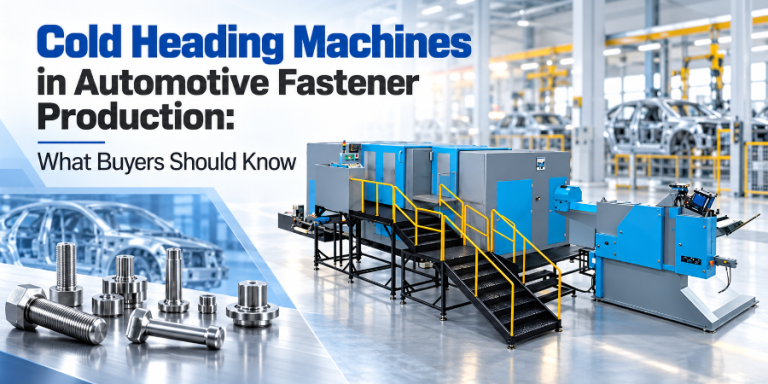

When a former runs at several hundred parts per minute, a small drift in tonnage or a slow rise in bearing temperature is easy to miss until it becomes a stoppage. A smart cold forming machine treats those signals as data rather than guesswork. In the sections below, we look at what that means in practice, why predictive maintenance changes the economics of a line, and what a buyer should ask before committing to equipment that has to stay relevant for the next ten years.
The term smart cold forming machine describes a former that couples its mechanical core with a control and sensing layer. At the base sits a programmable logic controller that coordinates the cutoff, transfer, and heading sequence. Around it, servo drives regulate motion with a precision that older clutch-based machines cannot match. Layered on top are sensors and a communication interface that turn the machine from a standalone press into a node on the plant network.
None of this replaces the fundamentals of cold heading. The metal is still upset and extruded at room temperature. What changes is the visibility. The operator and the maintenance team gain a continuous read on what the machine is doing, and that read is the foundation for every benefit that follows.
An IoT cold former relies on a set of instruments that report while the line is running. Force sensors on the main ram capture the tonnage of each stroke. Position encoders track where the transfer and knockout mechanisms are within their cycle. Temperature probes watch the tooling and lubrication zones. Vibration sensors listen to the bearings and drivetrain for patterns that precede wear.
These streams arrive in real time, which means the control system and any upstream software can show the current state of the machine at a glance. A supervisor no longer has to walk the floor to know whether a cell is healthy. The data also builds a baseline, and once a baseline exists, deviations become visible long before they turn into defects or breakdowns.
The practical payoff of all that data is predictive maintenance cold forging. Consider the tonnage curve of a healthy machine. It should be stable from stroke to stroke and from hour to hour. When the curve begins to creep upward, the cause might be a forming issue, a tooling change that is due, or a mechanical restriction building in the drivetrain.
Energy per stroke tells a similar story. A rise in the power drawn for the same output often points to friction, misalignment, or a deteriorating component. Because these indicators appear gradually, the maintenance team can schedule a repair during a planned window instead of reacting to a sudden failure. That single change, from reactive to planned, is what separates a controlled operation from one governed by luck.
For suppliers serving the automotive sector, the value of logged process data goes beyond uptime. Standards such as IATF 16949 expect demonstrable control over the production process, and auditors want evidence that critical parameters stayed within limits for the parts they received. A digital cold heading machine that records force, cycle, and setting data for each batch turns that expectation from a paperwork burden into a routine export.
Traceability also helps inside the plant. When a customer reports a field issue, the plant can pull the process record for the suspect lot and see whether the machine behaved normally on that day. That capability shortens root-cause analysis and protects a supplier’s standing with demanding accounts.
Connectivity changes how problems get solved. When a fault occurs, a remote specialist can view the same diagnostics the local team sees, sometimes without traveling to the site. For a plant whose equipment comes from a supplier several time zones away, that reach reduces the mean time to repair considerably.
Lower downtime is the direct result. A fault that once meant waiting for a field engineer to appear can instead be triaged within hours, with the right spare part already on its way. Over a year of production, the hours recovered from faster diagnosis often justify the sensing and communication investment on their own.
The control layer also supports efficiency. Servo and well-tuned drive systems deliver power when the stroke needs it and idle with lower draw between cycles, which suits plants under pressure to cut energy use. As regulators and customers tighten carbon-reduction expectations, a machine that can report its consumption per part gives a plant a defensible number to show in audits and sustainability reporting.
This matters because global supply chains increasingly ask suppliers to document the footprint of what they make. A former that measures its own energy draw turns that request from a manual estimate into a generated report.
Buyers should treat digital readiness as a specification. Ask suppliers whether the controller exposes process data through a standard interface, and whether the machine logs tonnage and cycle history that you can retrieve. Confirm that firmware can be updated, because the analytics you want in year three may not exist at purchase. Find out what sensors are fitted as standard versus offered as a later add-on, and whether remote diagnosis is supported by the vendor’s service team.
A machine that answers these questions openly will age better than one that simply runs fast today. The mechanical rate is still important, yet the ability to connect, log, and improve is what keeps the asset useful as Industry 4.0 cold heading becomes the norm rather than the exception.
Smart cold forming is not a distant concept. It is the steady addition of sensing, logging, and remote capability to a process that already runs at industrial scale. The benefits are concrete: earlier warning of failures, lower downtime through remote diagnosis, documented traceability for automotive customers, and a defensible energy record for carbon reporting.
No. A single connected former still delivers value through monitoring and maintenance alerts. Connectivity scales with your operation rather than demanding a complete overhaul.
Reputable setups support controlled network access and local logging. Buyers should ask about authentication and whether data can stay on the plant network if that is a requirement.
Sensing and logging run in parallel with production and do not affect cycle speed. The overhead is in data handling, not in the forming stroke.
In many cases yes, through external sensors and a gateway, though the depth of data is greater when sensing is built into the design. Retrofitting is a reasonable path for a critical existing asset.
Start by logging tonnage and cycle count on your highest-volume cell. That baseline alone supports most predictive maintenance work and costs far less than a full platform.
Contact Dongrui,Explore the full product range and request a quote to see how a connected former would fit your volume, part mix, and traceability requirements.
Table of Contents Introduction Why NEV is the fastest-growing market
Reading time: ~9 min | Categories: Cold Forging Technology, Industrial
Table of Contents Introduction What property classes mean The quench
1. Introduction When evaluating cold forming machines, the first number
 Optimized by Seraphinite Accelerator