Table of Contents Introduction What smart cold forming actually means
 Skip to content
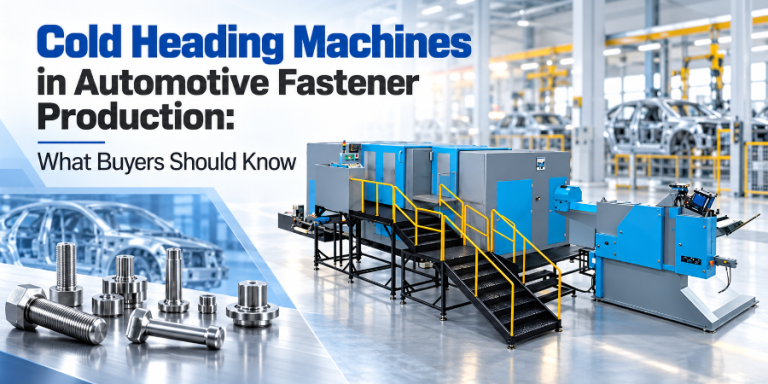

Cold heading, also called cold forming, has quietly become the default route for high-volume bolt, screw, and rivet production for exactly this reason. It is not a marketing gimmick. The process displaces metal at room temperature using successive dies, shaping wire into a finished or near-finished head and shank without removing material. When you look at the economics with the rigor an engineer would apply, the savings are measurable across three independent vectors: material, labor, and energy. This article walks through each one, then gives you a worksheet to estimate the savings for your own line.
The most direct cost advantage arises from dramatically reduced material waste. Conventional CNC machining produces fasteners by progressively turning down a round bar to form the shank and cutting threads,processes that generate chips at every machining pass. Industry data indicate that chip loss in such subtractive processes typically ranges from 30% to 60% of the original billet mass, depending on part geometry and dimensional tolerances.
In contrast, cold heading is an additive deformative process: the machine first shears wire into precise blanks, then reshapes them via controlled upsetting and extrusion without removing material. As a result, material utilization reaches 90–95%, reflecting minimal loss. For a high-volume facility processing hundreds of tons of wire monthly, this difference is operationally significant. It represents the distinction between a full bin of finished, saleable fasteners and a costly accumulation of swarf requiring disposal.
In essence, cold forming’s superior material efficiency reduces raw material procurement requirements per unit output while simultaneously lowering scrap handling, transportation, and disposal costs. On high-volume fastener production lines, this yield improvement frequently constitutes the single largest driver of overall manufacturing cost reduction.
A second saving arrives through automation density. A modern cold former is a continuous, high-rate process. A single unit such as a four-station former can produce anywhere from 75 to over 100 finished bolts per minute, and high-speed models push well beyond that. At those rates, one operator is not feeding the machine part by part. They are monitoring the line, swapping wire coils, and checking quality samples.
Compare that to a machining cell where an operator tends one part at a time through multiple setups. The labor cost per part in cold heading shrinks because the output per operator hour is dramatically higher. On a two-shift operation this effect compounds, since the same headcount supports far more throughput. For shops struggling with skilled-labor scarcity, this is also a resilience advantage, not just a cost one.
Energy is the third and most overlooked lever. A CNC lathe keeps a spindle spinning and a coolant pump circulating for the full cycle, even during non-cutting moves. Cold heading instead delivers a few short, high-force strokes and then lets the part advance. The motor draws power in bursts rather than continuously.
Because the process is cold, there is no furnace to heat billets and no large coolant loop fighting the heat of friction. The result is a lower energy cost per finished part. On a line producing millions of fasteners a year, the difference between a continuously running spindle and an intermittent high-force press adds up to a meaningful line item on the utility bill. When you frame the comparison as cold heading vs machining cost, energy is frequently the quiet factor that tips the decision.
The savings do not stop at the press. Because cold heading forms the head and often the shank profile in one flow, many parts skip the turning, milling, and grinding steps that machining would require afterward. Fewer operations mean fewer fixtures, fewer setups, less handling, and fewer points where a part can be scrapped.
That reduction in process steps translates directly into higher overall equipment effectiveness. The part spends less time in queues between machines, the floor space needed per unit of output drops, and the defect rate associated with multiple handoffs falls. For a lean operation, removing an entire secondary stage is often worth more than shaving a few percent off the primary cycle.
A fair cost analysis has to look past the purchase price. Cold heading machines are built as heavy industrial assets, with robust frames and tooling stations designed for sustained production. With proper maintenance, routine die changes, and lubrication discipline, a well-made former serves a plant for decades rather than years.
That long service life flattens the depreciation and amortization of the machine across a very large number of parts. When you divide the acquisition and upkeep cost by the millions of fasteners produced over a ten or twenty year span, the per-part equipment cost becomes small. This is the argument that separates a sound capital decision from a false economy built on a low sticker price.
To estimate your own savings, build a simple model around five variables. Start with the material price per kilogram of your wire. Multiply by the scrap rate you expect under machining versus the much lower scrap rate under cold forming. Then add labor rate per hour divided by parts per hour for each process. Layer in energy cost per part, which you can derive from motor power and cycle time. Finally, set your monthly production volume.
Run the two scenarios side by side and the gap in total cost per thousand parts will usually be large enough to justify the equipment change on its own. The worksheet is most useful when you plug in your real numbers rather than industry averages, because material grade and part complexity shift the result more than most buyers expect.
The case for cold heading is not built on slogans. It rests on three measurable facts: material utilization near 90 to 95 percent, labor spread across thousands of parts per operator hour, and energy spent in short bursts instead of continuous spindle time. Add the removal of secondary operations and a multi-decade service life, and the path to reduce fastener manufacturing cost becomes clear.
No. It works best for high-volume standard and near-standard bolts, screws, and rivets from ductile wire. Very low volumes or exotic geometries may still favor machining.
Cold working typically increases surface hardness and fatigue resistance in the head area, which is why formed fasteners perform well in structural applications.
Threads are usually rolled after heading, which is itself a cold process that strengthens the thread form rather than cutting it away.
Die life depends on the material and part, but with proper setup and lubrication, production runs of hundreds of thousands of parts per die set are normal.
The payback period depends on your volume and the scrap and labor rates you are replacing, yet the levers stack in the same direction.
Explore the full product range and request a quote to see how the numbers fit your volume and part mix.Contact Dongrui.
Table of Contents Introduction What smart cold forming actually means
Reading time: ~8 min | Categories: Cold Forging Technology, Industrial
1. Introduction If you’re in the market for a multi-station
1. Introduction In the highly competitive fastener manufacturing industry, efficiency,
 Optimized by Seraphinite Accelerator