Table of Contents Introduction Material utilization: cold forming achieves 90–95%
 Skip to content

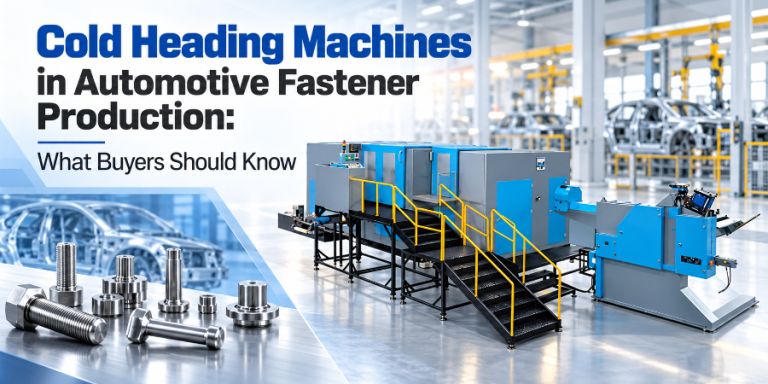
Fastener businesses live and die on margins measured in fractions of a cent. A high speed cold former rewrites that arithmetic by pushing throughput up without a proportional rise in labor, footprint, or energy. The logic is straightforward, yet the savings only materialize when volume, tooling, and changeover discipline line up.
A conventional cold header completes one part per stroke at a moderate rate, often well under a hundred pieces per minute for larger diameters. A high speed cold former is built around a rigid frame, precision feed, and a high frequency forming cycle, reaching several hundred strokes per minute. The physical difference is not just a faster motor; it is a shorter, more controlled stroke and a feed system tuned to keep material moving without hesitation. Because each stroke still produces a finished blank, raising the stroke rate raises output almost linearly while the hourly cost of the cell stays close to flat.
Four variables decide the unit cost. The cycle rate sets how many parts one machine hour yields. Labor is spread across those parts, so a faster cycle means a smaller labor slice per piece. Footprint matters because floor area, utilities, and handling equipment are fixed costs that a high speed machine amortizes over more output. Yield is the silent driver: a former running at speed but throwing scrap erases the gain, which is why high speed design also emphasizes stability and repeatability.
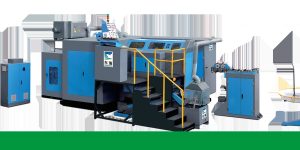
The DBHP-6 high speed cold former reaches up to 450 pieces per minute on M6 standard parts. At that rate a single line produces hundreds of thousands of bolts per shift, which is the volume profile where high speed pays for itself quickly. For a maker supplying one or two fast moving M6 specifications, this machine turns fixed overhead into a thin per piece cost.
The DBHP-8 carries the same high efficiency philosophy to M8 at up to 350 pieces per minute. The slightly lower rate reflects the larger cross section and heavier stroke, yet the economics are identical: one operator supervises a high output cell rather than several slower ones.
Low volume runs and frequent changeover erode the case. If a shop switches specifications several times a day, the setup time between campaigns can outweigh the per minute advantage. In that situation a flexible former with shorter changeover is the better tool, and the savings come from agility rather than raw speed.
Scrap rate is the first leak. A high speed line multiplies any defect rate, so a one percent reject at 450 pieces per minute discards far more material per hour than the same rate at low speed.Die wear is the third, because the higher stroke frequency stresses tooling faster, and unplanned stoppages cost more when each stopped minute represents more lost output. None of these is mysterious, and all are manageable with the right cadence.
Place a high speed former and a standard speed former side by side at equal shift cost. The high speed unit yields several times the parts.The standard machine wins only when its lower tooling stress and simpler setup suit a mixed, low volume mix. For a steady high volume standard part, the unit cost gap is wide enough that the high speed machine usually recovers its premium inside a normal production year.
A plant running a single high volume M6 or M8 specification can consolidate output onto one or two high speed lines instead of a bank of slower machines. Fewer machines means less maintenance surface, fewer operators, and a cleaner cost structure that buyers notice in the quote.
A compact high speed line delivers more output per square meter, which suits a shop where floor space is constrained. The official line describes these machines as built for high efficiency and efficient utilization of manpower and space, and that claim shows up directly in a smaller cost per part when rent and handling are part of the equation.
Extreme low volume is simply not economical on a high speed platform. The machine earns its keep through volume, so a shop whose orders arrive in small, varied batches should weigh changeover friendly equipment first.
Treat overall equipment effectiveness as the metric, not peak speed. Keep changeover short so the machine spends its time forming, not waiting. Manage yield through disciplined wire preparation and lubrication so the high stroke rate translates into good parts rather than scrap. Together these habits convert a fast machine into a low cost one.
Choosing a high speed cold former is a volume decision before it is a machine decision. If your order book is dominated by one or two standard specifications in the millions, a high speed line at up to 350 pieces per minute will lower your cost per fastener more than any small efficiency tweak. For larger diameters, the DBF-134L cold forming machine covers standard 8 to 12 mm bolts, the DBP-136L part former adds non standard capability in the same range, and the DBP-206L six station part former extends to 12 to 20 mm.
It is the maximum rated speed of the DBHP-6 on an M6 standard part, published by the manufacturer for that specification. Real world output is lower because wire quality, lubrication, tooling condition, and setup all affect the sustainable rate, so treat 450 as the ceiling rather than the everyday number.
The gain comes from spreading fixed costs over more parts. At equal shift and labor cost, a machine producing several times the output cuts the labor and facility slice per piece by a comparable factor, often bringing unit cost down by a meaningful share on steady high volume work. Exact numbers depend on your volume, scrap, and utility rates.
Not inherently. A well set up high speed former holds tolerance as reliably as a slower one. The risk is that any defect rate is multiplied by the higher throughput, so scrap control through material preparation and in line checks matters more, not because the machine is worse but because it moves faster.
The DBHP-8 reaches up to 350 pieces per minute on M8 standard parts and follows the same high efficiency, space saving design as the DBHP-6. It is the natural choice when your dominant specification is M8 rather than M6.
Usually no. The economic case rests on volume.
Table of Contents Introduction Material utilization: cold forming achieves 90–95%
1. Introduction If you’re in the market for a multi-station
1. Introduction In the highly competitive arena of high-volume industrial
1. Introduction A finished bolt sitting in a bin looks
 Optimized by Seraphinite Accelerator