1. Introduction For decades, “Made in China” in the machinery
 Skip to content

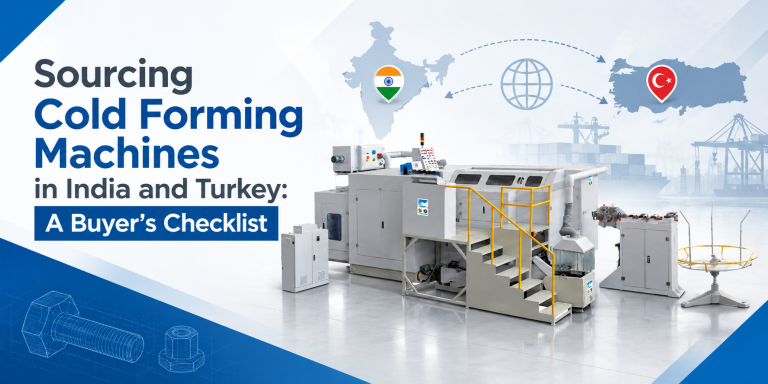

India and Turkey are two of the fastest growing fastener manufacturing bases outside China, and both feed large domestic construction and automotive sectors while exporting into Europe, the Middle East, and beyond.A buyer who treats the purchase as a line item rather than a supply chain relationship usually discovers the gap after commissioning, not before.
Both countries run sizeable fastener industries with a clear export orientation. India supplies a broad mix of standard and engineered fasteners to construction and automotive supply chains. Turkey sits closer to the European OEM market and leans into automotive grade parts where consistency and documentation carry as much weight as price. In both cases the buyer’s real requirement is throughput per shift at a known, repeatable quality level, because export orders are won on the ability to deliver the same part month after month.
Local assembly can shorten lead time, yet many buyers still import a quality former for three reasons. Consistency of the formed part protects export contracts. Lead time from a proven supplier is predictable once the relationship is established. After sales, including spares and commissioning support, decides whether a stoppage lasts a day or a week. These are operational factors, not brand preferences, and they matter more as volumes rise.
High volume standard bolt production is the backbone of the Indian market. The DBHP-6 high speed cold former delivers up to 450 pieces per minute on M6 standard parts, while the DBHP-8 reaches up to 350 pieces per minute on M8. For the larger 8 to 12 mm standard bolt range, the DBF-134L cold forming machine covers diameters up to 12 mm under the head at up to 160 mm length. Together the DBHP and DBF lines match the standard part profiles that dominate domestic and export orders.
Automotive grade supply demands flexible, multi station capability for non standard and engineered parts. The DBP-136L part former handles standard and non standard bolts and parts from 8 to 12 mm, and the DBP-206L six station part former extends to 12 to 20 mm at up to 220 mm length. For automotive M8 volumes the DBHP-8 remains relevant, but the DBP series is where shaped and combined geometries are formed in one pass, which is what OEM documentation usually calls for.
Job shops in both countries live on variety. The same DBP-136L and DBP-206L machines serve this role, because their ability to run standard and non standard parts in one platform limits the number of dedicated setups a shop must hold. For a job shop the question is not top speed but how quickly it can move between specifications without losing accuracy.
Duty and import procedure are the first hurdle, and they vary by product classification in each country. Shipping and insurance add lead time that a production plan must absorb. Installation and commissioning need either in house skill or supplier support on site. Spares availability decides recovery time after wear. Training determines whether operators reach rated output. None of these is visible on a quotation, yet each one shapes the real cost of ownership.
A locally assembled former can win on lead time and on site service language. An imported quality former typically wins on proven consistency, documented performance, and the backing of an established manufacturer with export experience. The honest comparison is not which is cheaper on paper, but which keeps the line running and the parts conforming over the years the machine stays in service.
A small Indian bolt maker concentrating on M6 to M12 standard parts can start with a DBHP-6 or DBHP-8 for the high volume size and add a DBF-134L for the upper diameter range. The footprint stays manageable, which suits an SME where floor space and working capital are both tight.
A Turkish plant serving European automotive tiers is more likely to invest in DBP series flexibility, because export orders mix standard and engineered parts and reward a former that holds tolerance across changeovers. The argument there is not peak speed but conformance and traceability.
Service radius is real. The farther the machine sits from the supplier, the more a buyer depends on local spares stock and trained technicians. Language and compliance paperwork add friction at customs and during commissioning. These limits do not rule out importing, but they raise the importance of a clear support agreement before payment.
Define acceptance criteria before shipment so commissioning has a measurable target. Insist on operator and maintenance training as part of the deal, not an extra. Negotiate a spare parts agreement that covers the wear items you will consume first, because a worn die waiting on a shipment is lost production. Hold those three points and the import stops being a gamble.
Choose the model by the demand you actually serve. Indian standard bolt makers should look at the DBHP-6 high speed cold former and DBHP-8 for high volume M6 and M8, with the DBF-134L cold forming machine for 8 to 12 mm standard bolts. Turkish automotive and non standard shops should weigh the DBP-136L part former and DBP-206L six station part former for their flexible, multi station capability.
For the dominant Indian standard bolt trade, the DBHP-6 for M6 at up to 450 pieces per minute and the DBHP-8 for M8 at up to 350 pieces per minute are the high volume choices, with the DBF-134L covering 8 to 12 mm standard bolts. The fit depends on which diameters make up most of your orders.
Automotive grade work in Turkey leans toward the DBP series, because shaped and combined parts need multi station flexibility. The DBP-136L covers 8 to 12 mm standard and non standard parts, and the DBP-206L covers 12 to 20 mm. For straight M8 automotive volume the DBHP-8 still applies.
Duty depends on the local tariff classification for cold forming machinery in each country, so the reliable step is to confirm the HS code with a customs broker before quoting. Lead time combines manufacturing, export packing, ocean freight, and customs clearance, and the supplier can state the ex works production window while the broker estimates the clearance side.
The same DBP-136L and DBP-206L platforms serve job shops in India and Turkey, because running standard and non standard parts on one machine reduces the number of dedicated setups. The deciding factor is changeover speed and tooling familiarity, not peak throughput.
Secure them as a contract item, not an assumption. Agree on commissioning support, operator training, and a spare parts list covering the wear items you will use first.
1. Introduction For decades, “Made in China” in the machinery

Table of Contents Introduction What Is a Multi-Station Cold Former
Table of Contents Introduction The Fundamental Difference in Material Usage
Table of Contents Introduction What thread rolling is What thread
 Optimized by Seraphinite Accelerator