1. Introduction In the highly competitive fastener manufacturing industry, efficiency,
 Skip to content
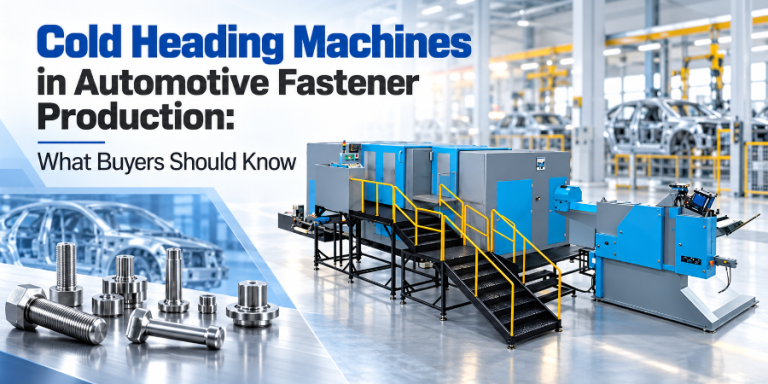
Every fastener manufacturer faces the same fundamental question: what is the most cost-effective way to transform raw steel wire into a finished bolt, nut, or specialized part? The answer is rarely simple. Three dominant processes — cold forging, hot forging, and CNC machining — each offer distinct advantages in material efficiency, part strength, dimensional precision, and production speed.
Choosing the wrong process can mean the difference between a profitable production line and one that bleeds margin on every part. Select hot forging when cold forging would suffice, and you waste energy and lose dimensional precision. Choose CNC machining for a high-volume standard bolt, and you may discard 40–60% of your raw material as chips. Pick cold forging for an oversized alloy steel component, and you risk tool failure and excessive die wear.
This guide compares all three processes — cold forging vs. hot forging vs. machining — across the factors that matter most to fastener manufacturers: temperature range, material waste, mechanical strength, surface finish, production speed, tooling cost, and part complexity. We also provide a cost-per-part framework and a decision guide to help you match the right process to your specific production scenario.
Table of Contents
Cold forging — also called cold heading or cold forming — is a metal-forming process that shapes wire or rod stock at or near room temperature, well below the material’s recrystallization point. A slug of wire is fed into a multi-station cold header, where successive punches and dies progressively deform the metal into the desired fastener shape through a combination of upsetting (compressing the end to form a head), extrusion (reducing the shank diameter), and trimming (removing flash).
The defining principle of cold forging is volume constancy: the material is rearranged, not removed. A fixed volume of wire enters the die, and the same volume exits as a shaped blank. This is fundamentally different from machining, which removes material to create geometry.
Because the metal is worked below its recrystallization temperature, cold forging induces work hardening — the grain structure deforms and strengthens along the part’s contour. The result is a fastener whose internal grain flow follows the part shape rather than being interrupted, producing superior fatigue strength and impact resistance compared to machined parts cut from bar stock.
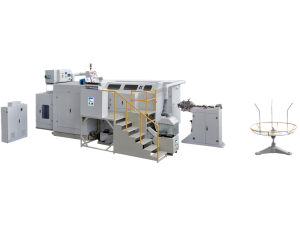
Modern multi-station cold formers, such as the Dongrui DBHP-6 High-Speed Cold Former, can produce standard M6 fasteners at rates up to 450 pieces per minute across 4, 5, or 6 forging stations — with near-zero scrap and a surface finish that mirrors the die’s polished condition.
Key characteristics of cold forging:
Hot forging shapes metal at elevated temperatures — typically between 700°C and 1,200°C for steel — above the material’s recrystallization point. At these temperatures, the metal becomes highly ductile and requires significantly less force to deform, allowing the formation of larger parts and more complex geometries that would be impossible or impractical in cold forging.
The hot forging process involves three main stages: heating the billet in a furnace to the target temperature, deforming the heated metal in a die using a press or hammer, and cooling the part under controlled conditions to prevent defects from rapid temperature changes.
A key metallurgical advantage of hot forging is grain refinement through recrystallization. As the metal is heated and deformed, new equiaxed grains form, replacing the elongated grains from the deformation process. This produces a uniform, refined microstructure with improved mechanical properties — particularly toughness and ductility.
However, hot forging has significant trade-offs for fastener production:
Hot forging is typically reserved for large-diameter fasteners (above M20), parts forged from high-strength alloy steels that resist cold forming, or components with geometries too complex for multi-station cold heading.
CNC (Computer Numerical Control) machining creates fastener shapes by removing material from bar stock or billet using precision cutting tools. Common machining operations for fasteners include CNC turning (for cylindrical shanks and heads), milling (for flats, slots, and hex features), and thread cutting (for internal or external threads).
Unlike forging, which rearranges material, machining is a subtractive process. For a typical hex bolt, CNC turning removes material from a larger-diameter bar to create the reduced shank, then machines the hex head — generating chips that represent raw material waste. Depending on part geometry, 30–60% of the original bar stock can end up as scrap.
The primary advantage of CNC machining is geometric flexibility. A CNC machine can produce virtually any shape that can be described in CAD, including complex internal features, asymmetrical geometries, and multi-axis contours that no forging die could create. Setup time is also minimal — changing from one part to another often requires only a new program and tool change, with no custom die manufacturing.
However, the trade-offs are significant for volume fastener production:
The following table summarizes the key differences across all three processes:
| Factor | Cold Forging | Hot Forging | CNC Machining |
|---|---|---|---|
| Temperature | Room temperature | 700–1,200°C | Room temperature (cutting heat only) |
| Material Waste | Near zero (volume constancy) | Low–moderate (flash, scale) | High (30–60% as chips) |
| Strength | High (work hardened, grain follows contour) | Moderate–high (refined grain, but less work hardening) | Lower (grain interrupted by cutting) |
| Surface Finish | Excellent (mirrors die) | Poor (scale, requires finishing) | Good (tool marks visible) |
| Dimensional Tolerance | ±0.05mm | ±0.5mm | ±0.01mm or tighter |
| Production Speed | 200–450 pcs/min | 20–60 pcs/min | 5–30 pcs/min |
| Tooling Cost | High (custom carbide dies) | Moderate (die + furnace) | Low (standard cutting tools) |
| Part Complexity | Simple to medium | Medium to high | Very high (unlimited) |
| Max Part Size | Up to ~M20 (machine dependent) | Virtually unlimited | Limited by machine envelope |
| Break-Even Volume | 10,000–50,000 pcs | 5,000–20,000 pcs | 1–1,000 pcs (prototype runs) |
Cold forging is the clear winner when your production scenario matches most of the following criteria:
For example, a manufacturer producing M6 hex bolts at 450 pieces per minute on a Dongrui DBHP-6 cold former with 4–6 forging stations can achieve material utilization rates approaching 100%, with a per-part cost structure that machining simply cannot match above 10,000 pieces.
For larger-diameter fasteners (M8 and above), the Dongrui DBHP-8 delivers 350 pcs/min with the same volume constancy and work-hardening benefits, extending cold forging’s cost advantage to medium-diameter applications.
Cold forging is not universally optimal. There are production scenarios where hot forging or CNC machining is the correct engineering and economic choice:

A common hybrid approach is to cold form the blank first, then perform secondary CNC machining for features that cannot be forged — such as cross-drilled holes, milled flats, or internal threads. This combines the material efficiency and strength of cold forging with the geometric flexibility of machining.
To make an informed process decision, you need to compare total cost-per-part across all three methods. The key cost components are:
| Cost Component | Cold Forging | Hot Forging | CNC Machining |
|---|---|---|---|
| Tooling Investment | High (carbide dies, $8,000–$30,000+) | Moderate (dies + furnace, $3,000–$15,000) | Low (standard tools, $500–$2,000) |
| Raw Material per Part | Lowest (near-100% utilization) | Low (flash + scale loss) | Highest (30–60% chip waste) |
| Cycle Time per Part | 0.13–0.3 sec | 1–3 sec | 2–12 sec |
| Energy per Part | Low (motor only) | High (furnace heating) | Moderate (spindle + cooling) |
| Secondary Operations | Thread rolling (minimal) | Descaling, finishing, sometimes threading | Deburring, sometimes surface treatment |
| Setup / Changeover | 2–8 hours (die change) | 2–6 hours (die + furnace) | 15–60 min (program + tool) |
How to calculate your break-even point:
The break-even volume is the production quantity at which the total cost of cold forging (including tooling) equals the total cost of CNC machining. Below this volume, machining is cheaper. Above it, cold forging wins.
Simplified Break-Even Formula
Break-Even Volume = Cold Forging Tooling Cost ÷ (Machining Cost-per-Part − Cold Forging Cost-per-Part)
Note: Cost-per-part includes raw material, energy, labor, and machine depreciation. Actual values vary by part geometry, material grade, and local costs.
For most standard fasteners (M6–M12, carbon steel), the break-even volume typically falls between 10,000 and 50,000 pieces. Below that, CNC machining may be more economical. Above it, cold forging’s material savings and speed advantage dominate.
When evaluating equipment for cold forging production, consider machines like the Dongrui DBP-206L Six-Station Part Former, which handles standard and non-standard bolts from 12–20mm diameter — a range that covers many commercial and structural fastener applications.
Yes, but stainless steel (particularly SS304 and SS316) is significantly harder to cold form than carbon steel due to its higher work-hardening rate and galling tendency. A multi-station cold former with 5 or 6 stations can distribute the deformation across multiple blows, reducing per-station stress. Proper lubrication (phosphate + soap or molybdenum disulfide) and carbide tooling with TiN or TiAlN coatings are essential. Contact Dongrui’s engineers to discuss stainless steel cold forming configurations.
Not necessarily. While hot forging requires less forming force for large diameters, the total cost includes furnace energy, scale loss, descaling, and secondary finishing. For medium-large fasteners (M14–M20), cold forging on a high-capacity part former may still be more economical at sufficient volume. The decision depends on your specific part size, material, and annual volume — calculate the full cost-per-part before choosing.
For standard carbon steel fasteners, cold forging typically becomes cost-effective above 10,000–50,000 pieces annually, depending on part complexity and material cost. Below this threshold, the tooling investment may not amortize sufficiently. For specialty alloys or complex geometries, the break-even volume may be higher. Quick-change tooling systems have reduced this threshold in recent years.
No. In fact, cold-forged fasteners are typically stronger than machined equivalents of the same material. Cold forging work-hardens the metal and produces a grain structure that follows the part’s contour, enhancing fatigue strength and impact resistance. CNC machining cuts across the grain, interrupting the material’s natural fiber structure and producing a part with lower fatigue performance.
Yes — a hybrid approach is common in modern fastener plants. The cold header produces the blank (shank + head), and a secondary CNC station machines features that cannot be forged, such as cross-drilled holes, milled flats, or internal threads. This approach maximizes material efficiency from cold forging while retaining the geometric flexibility of machining for complex features.
There is no single “best” fastener manufacturing process — only the right process for your specific combination of part size, material, volume, tolerance, and cost targets. Here’s the decision framework in summary:
For most commercial fastener manufacturers, cold forging remains the most cost-effective process at production volumes above the break-even threshold. Dongrui, as a cold forging machine manufacturer with exports to 145+ countries, offers a full range of multi-station cold formers and part formers to match your production requirements — from the high-speed DBHP-6 (450 pcs/min for M6) to the heavy-duty DBP-206L (12–20mm part former).
Need Help Choosing the Right Cold Forging Machine?
Tell us your fastener specifications, material, and annual volume. Our engineers will recommend the optimal machine configuration and provide a detailed quotation.
Dongrui Equipment (Zhejiang DongRui Machinery Industry Co., Ltd.) is a National High-Tech Enterprise specializing in cold heading machines and multi-station cold formers. Products are exported to 145+ countries including India, Turkey, Russia, Brazil, and Southeast Asia. Visit our website for product specifications and quotations.
1. Introduction In the highly competitive fastener manufacturing industry, efficiency,
Table of Contents Introduction What thread rolling is What thread
Table of Contents Introduction The Fundamental Difference in Material Usage
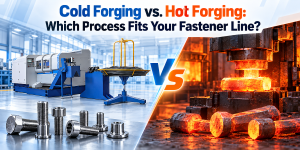
Table of Contents Introduction What Is Cold Forging and Why
 Optimized by Seraphinite Accelerator