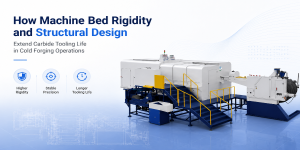
1. Introduction When a cold heading machine runs at 350–450
 Skip to content

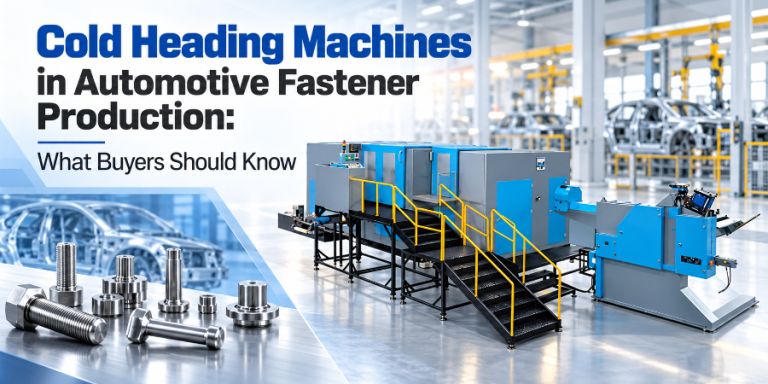

Two plants can ship bolts that look identical on the shelf and still sit at very different costs per thousand. The gap rarely comes from labor rates or raw steel price. It comes from the forming process chosen long before the first part is boxed. Buyers and production managers who are scaling a fastener line or shifting to a new specification often assume the process is fixed by the part. In practice, cold and hot forging are both valid routes to a finished bolt, and the right call depends on diameter, volume, and the material in the coil. This article lays out how the two processes differ, where each one earns its place, and how to match equipment to the parts you actually run.
Cold forging deforms steel at or near room temperature, well below the metal’s recrystallization point. The wire is fed, cut, and squeezed into shape by successive die stations without any furnace heating. Hot forging heats the billet to roughly 1100 to 1250 degrees Celsius for carbon steel, above recrystallization, so the material flows under far lower force but picks up scale and loses dimensional sharpness. The temperature boundary is the single fact that drives every other difference in surface quality, scrap rate, and downstream machining.
Cold forging keeps the material’s grain flow continuous along the part contour, which raises fatigue resistance compared with a machined or roughly hot-formed section. The surface leaves the die smooth and scale free, so plating and thread rolling behave predictably. Because the process is near net shape, material yield stays high and offcut scrap is minimal. For high volume standard fasteners, those three properties translate into lower unit cost and steadier quality than hot forging can deliver at the same diameter.
The natural home of cold forging is the high volume standard fastener: hex bolts, screws, and studs in the small to medium diameter range. Lines built for these parts run continuously, and the economics depend on cycle speed more than on forming force. This is where multi station cold headers justify themselves, because a single machine turns wire into a headed blank at hundreds of pieces per minute.
Cold forming is not limited to round standard bolts. With the right tooling, headed and bent shapes, flanged bodies, and asymmetric collars can be produced in one flow. The constraint is tool access and die load rather than part geometry alone. Shaped parts that would need heavy machining after hot forging often come out closer to finished from a cold former, which is why custom fastener makers invest in flexible stations.
Hot forging remains the better route for very large diameters, high alloy steels that are too hard to cold form without extreme press force, and parts where a refined or normalized microstructure is specified by the print. Above roughly M24, and for many special alloys, heating the billet is cheaper than building a cold header strong enough to squeeze it. No cold line should be forced into that envelope.
Cold forging asks a great deal of the dies because the material is worked in its hardest practical state. The wire must arrive below a hardness ceiling that the tool steel can contain, which is why high carbon and alloy grades are usually annealed before heading. Work hardening during the stroke raises the load on later stations, and poor lubrication lets the surface drag instead of flow. Die wear, then, is rarely a mystery. It traces back to wire condition, coating quality, and whether the station count matches the reduction per blow.
A cold header line wins on precision and scrap. Parts leave near net shape with tight tolerance, so thread rolling and plating need little correction. Cycle time is measured in fractions of a second per piece, and energy per part is low because there is no furnace to hold at temperature. A hot forge line needs less press tonnage and handles harder stock, but it carries scale, a wider machining allowance, and continuous furnace energy. On standard fasteners at volume, cold forging almost always holds the lower landed cost.
Engine, chassis, and body fasteners are the clearest case for cold forging. Volumes are high, grades are specified, and fatigue life matters. A cold header feeding an inline thread roller delivers consistent strength class parts with minimal handling, which is why automotive supply chains standardize on the process for everything inside the M20 envelope.
Small screws and terminal hardware benefit from the surface finish and dimensional repeatability of cold forming. At this scale, the scrap saved by near net shape is a large share of the part value, and hot forging would simply be too coarse for the tolerance.
If the print calls for a diameter the cold line cannot contain, or the alloy will not soften enough to head, the answer is either change the material to a more formable grade or move the operation to hot forging. Recognizing that boundary early prevents die failures and late rework that cost more than the process change would have.
Tooling life is mostly set upstream of the machine. Proper wire pre treatment, usually annealing followed by phosphating and a soap or polymer lubricant, lets the steel flow instead of seize. Selection of die material, carbide for high wear stations and tool steel where toughness matters, protects the line as volume climbs. Stable lubrication and clean wire do more for cost per piece than any single speed setting, because they keep the dies in service between reconditioning.
The choice between cold and hot forging is not a matter of which is modern. It is a match between part type, diameter, and volume. For standard and shaped fasteners up to about 20 mm, cold forging delivers the strength, surface, and material yield that make a line profitable.
Zhejiang DongRui builds cold formers across that full range, so the model can be set by the work in front of you. The DBHP-6 high speed cold former reaches 450 pieces per minute for M6 standard parts, while the DBHP-8 handles M8 at 350 pieces per minute. For 8 to 12 mm, the DBF-134L covers standard bolts and the DBP-136L adds non standard shapes, with the DBP-206L extending to 12 to 20 mm at up to 220 mm length. Tell us your diameter, grade, and monthly volume, and we will point to the header that fits the line rather than the one that simply exists in the catalog.
For fatigue loaded joints, cold forged bolts usually hold an edge because the grain flow follows the contour and work hardening adds surface strength. Tensile class after heat treatment can match between the two processes, so the real difference shows up in repeatability and fatigue life rather than in a single tensile number.
Cold heading covers small screws through roughly 20 mm in production equipment. Above that, press force and tool stress rise fast, and hot forging becomes the economical route. Within the M20 envelope, cold forging is the default for standard and shaped fasteners.
Not when the wire and lubrication are right. Die wear is driven by material hardness, reduction per station, and coating quality. With annealed, phosphated, well lubricated wire and a sensible station count, carbide dies run long campaigns before reconditioning.
Yes. Shaped and flanged bodies are formed cold with dedicated tooling, often closer to finished than a hot forged blank would be. The limit is die access and load, not geometry, which is why flexible station formers exist for custom work.
Switch when the diameter exceeds the cold line’s capacity, when the alloy is too hard to head without extreme force, or when the specification demands a microstructure that cold work cannot deliver. Those are process boundaries, not quality failures, and recognizing them early saves tooling.
1. Introduction When a cold heading machine runs at 350–450
Table of Contents Introduction The Fundamental Difference in Material Usage
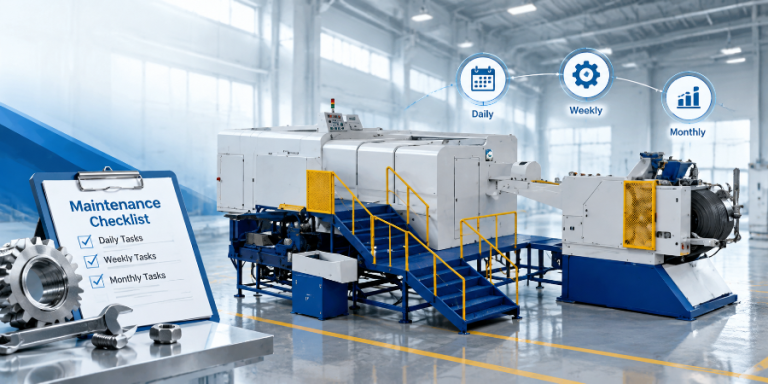
Table of Contents Introduction How to Use This Checklist Daily
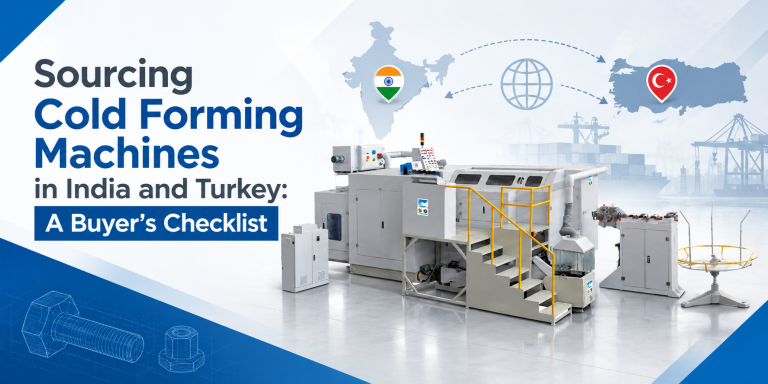
1. Introduction When evaluating cold forming machines, the first number
 Optimized by Seraphinite Accelerator